


Europe’s Solar Railways Could Transform the Future of Clean Transportation
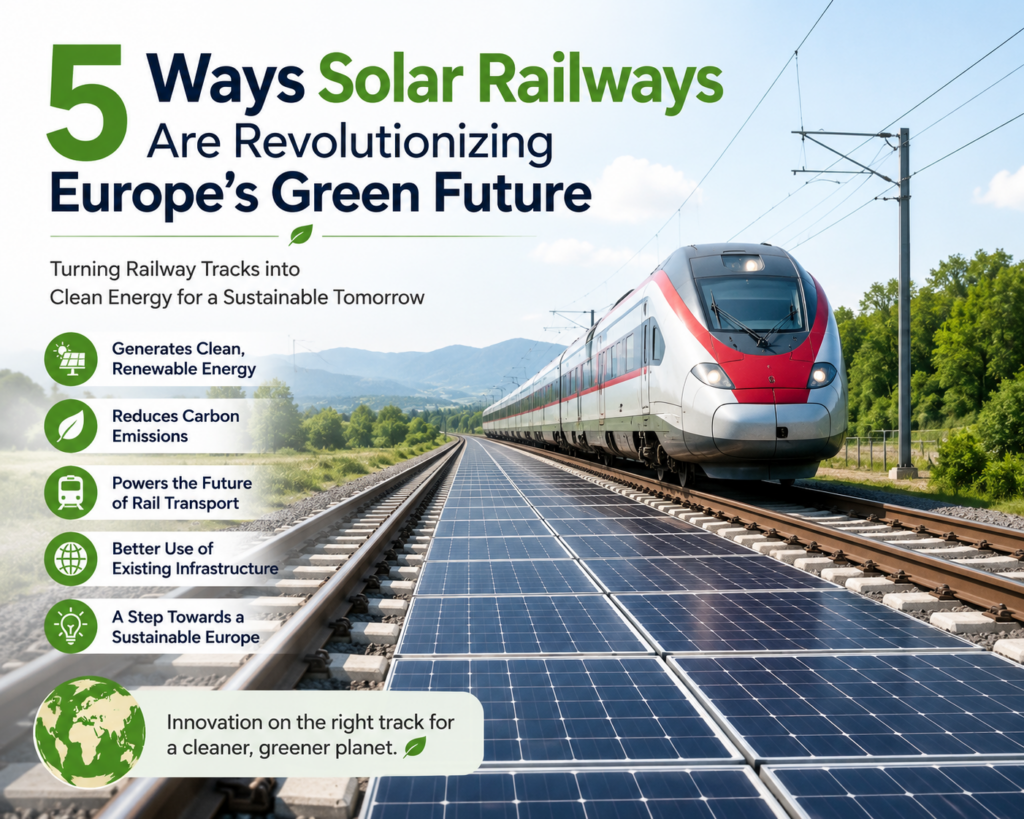
As countries around the world search for smarter ways to produce clean energy, Europe is exploring an innovative idea that could change the future of rail transport—solar railways. Instead of using valuable farmland or building new solar farms, engineers are testing a system that installs solar panels between active railway tracks, allowing existing transport infrastructure to generate renewable electricity.
The idea has moved beyond theory. A successful pilot project in Switzerland has encouraged plans for expansion, with Italy preparing to launch its own solar railway project. If future trials continue to deliver positive results, solar-powered rail infrastructure could become an important part of Europe’s clean energy transition.
A World-First Pilot in Switzerland
The breakthrough began in the Swiss village of Buttes, where clean-energy startup Sun-Ways installed the world’s first removable solar panels directly between the rails of an active railway line.
The pilot project covers a 100-metre section of track and includes 48 specially designed photovoltaic panels capable of generating 18 kilowatts peak (kWp) of electricity. Unlike conventional solar farms, the panels were installed without disrupting train services, demonstrating that renewable energy systems can coexist with existing railway operations.
One year into what was originally planned as a three-year trial, the project has already exceeded expectations. More than 11,000 trains have safely passed over the installation, while the solar panels have continued producing electricity without requiring unusual maintenance. During its first year, the pilot generated around 16,000 kilowatt-hours (kWh) of electricity—roughly equivalent to the annual electricity consumption of an average household in the United Kingdom.
Italy Plans the Next Step
Encouraged by Switzerland’s early success, Italy is preparing to become the next European country to test solar railway technology.
Sun-Ways has signed a collaboration agreement with an Italian partner that is working with the country’s national railway infrastructure manager. Plans for a pilot installation are expected to move forward, making Italy one of the first countries to evaluate whether the technology can be adapted to larger railway networks.
Interest is also growing beyond Europe. According to Sun-Ways, discussions are underway with organizations in South Korea, the Netherlands, India, China, and Singapore, suggesting that the technology could eventually be tested in different climates and railway systems.
Making Better Use of Existing Infrastructure
One of the biggest advantages of solar railways is that they use land that is already dedicated to transport.
Instead of clearing additional space for solar farms, railway corridors can become sources of renewable energy without competing with agriculture or urban development. The electricity produced could initially be supplied to the public power grid and, in the future, potentially power railway substations or even trains themselves.
Sun-Ways estimates that if similar systems were installed across Switzerland’s 5,317-kilometre railway network, they could generate approximately one terawatt-hour (TWh) of electricity every year—around 2% of the country’s annual electricity consumption.
A Balanced Perspective
Although the early results are encouraging, experts caution that solar railways are still in the testing phase.
Solar panels installed flat between railway tracks produce slightly less electricity than tilted rooftop panels. Engineers also continue to study long-term durability, maintenance requirements, safety, and costs. Earlier concerns included glare for train drivers, damage from vibration, and cleaning challenges.
According to the developers, these issues have been addressed through reinforced panel designs, anti-reflective coatings, built-in monitoring systems, and cleaning brushes attached to trains. However, larger-scale projects will be needed to confirm whether the technology remains practical over many years and under different operating conditions.
Why This Matters
The solar railway project demonstrates how innovation can make existing infrastructure more sustainable.
Rather than building entirely new energy facilities, countries are finding creative ways to integrate renewable energy into systems that people already use every day. If future trials continue to succeed, railway corridors could become valuable sources of clean electricity while reducing carbon emissions and making transport networks more energy efficient.
Perhaps the most inspiring aspect of this project is its practical approach. It shows that the transition to renewable energy does not always require massive new construction. Sometimes, rethinking how existing infrastructure is used can unlock entirely new possibilities.
While more testing is needed before widespread adoption, Switzerland’s successful pilot and Italy’s planned expansion offer a glimpse into what the future of sustainable transportation could look like. The project is a reminder that innovation, engineering, and environmental responsibility can work together to create smarter, cleaner solutions for generations to come.
Read more about Positive News