


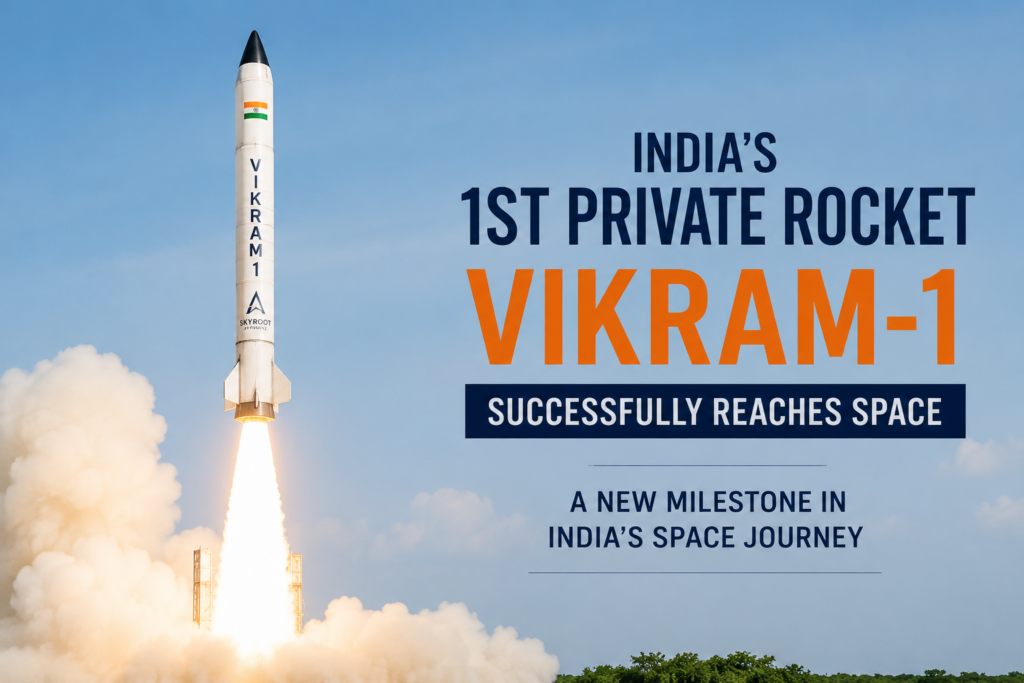
India’s First Private Rocket Reaches Space: A New Milestone in Innovation
India has taken a giant leap in its space journey with the successful launch of Vikram-1, the country’s first privately developed orbital rocket. Built by Hyderabad-based Skyroot Aerospace, the rocket was launched on 18 July 2026 from the Satish Dhawan Space Centre in Sriharikota. This historic achievement marks the beginning of a new era where Indian private companies are playing an active role in space exploration alongside ISRO.
A Proud Moment for India
For many years, India’s space missions have been led by ISRO, which has earned worldwide recognition through missions like Chandrayaan, Mangalyaan, and Aditya-L1. Now, the success of the historic mission shows that Indian startups are also capable of achieving world-class milestones.
The launch is a proud moment not only for Skyroot Aerospace but for the entire nation. It demonstrates that India’s private sector has the talent, technology, and determination to contribute to the country’s growing space ambitions.
What is Vikram-1?
Vikram-1 is an orbital launch vehicle designed to carry small satellites into Low Earth Orbit (LEO). The rocket stands about 22 metres tall and can carry payloads weighing up to 350 kilograms.
It uses advanced technologies, including 3D-printed rocket engine components, lightweight carbon-composite structures, and a three-stage propulsion system. These innovations make the rocket more efficient while reducing manufacturing time and cost.
Why This Launch is Important
The success of Vikram-1 is much more than a successful rocket launch. It represents a turning point for India’s private space industry.
The mission proves that Indian startups can build complex space technologies that meet international standards. This achievement is expected to encourage more entrepreneurs to invest in space technology and inspire new companies to enter the sector.
The launch also supports India’s goal of becoming a global hub for commercial satellite launches. As demand for launching small satellites continues to grow worldwide, Indian companies now have an opportunity to compete in this expanding market.
Benefits Beyond Space
Space technology affects our everyday lives more than many people realize. Satellites launched into orbit help provide GPS navigation, weather forecasting, internet connectivity, television broadcasting, disaster management, agriculture monitoring, and environmental research.
With successful private launch vehicles like Vikram-1, launching satellites can become faster and more affordable. This means universities, research organizations, startups, and businesses will have greater access to space technology for innovation and development.
A Boost for Young Innovators
One of the most inspiring aspects of this achievement is the message it sends to young Indians.
Skyroot Aerospace was founded by former ISRO engineers who believed that private companies could contribute to India’s space program. Their success shows that innovative ideas, hard work, and determination can lead to extraordinary achievements.
This milestone is likely to encourage students to explore careers in science, technology, engineering, and mathematics (STEM). It also highlights the importance of entrepreneurship and research in building India’s future.
Government Support for Private Space Companies
India opened its space sector to private participation in 2020, allowing startups to work alongside ISRO. Since then, several companies have entered the industry, developing launch vehicles, satellites, and space technologies.
The success of Vikram-1 demonstrates that this policy is delivering positive results. Experts believe that stronger collaboration between government agencies and private companies will help India become one of the leading space economies in the world over the coming decade.
Looking Towards the Future
Although Vikram-1 is the first orbital rocket developed by Skyroot Aerospace, it is only the beginning of a much larger journey. The company plans to develop more advanced launch vehicles capable of carrying heavier satellites and serving customers from around the world.
As India’s private space ecosystem continues to grow, more innovations, startups, and successful missions are expected in the coming years. These developments will strengthen the country’s position in the global space industry while creating new opportunities for employment, research, and technological advancement.
Conclusion
The successful launch of Vikram-1 is a landmark achievement for India. It proves that Indian startups can build advanced space technology and compete on the global stage. More importantly, it reflects the country’s growing culture of innovation, entrepreneurship, and scientific excellence.
As India’s first privately developed orbital rocket reaches space, it opens the door to countless new possibilities. It is not just a victory for Skyroot Aerospace—it is a victory for every Indian who believes in dreaming big, embracing innovation, and reaching for the stars.
Visit Skyroot Aerospace or Learn more from ISRO
Read more positive news.