










India’s Private Sector Begins 2026 on a Strong Note
As the new year unfolds, there is encouraging news for India’s economy. After showing signs of slowing down toward the end of 2025, India’s private sector has regained momentum in January 2026, offering a hopeful start to the year for businesses, workers, and policymakers alike.
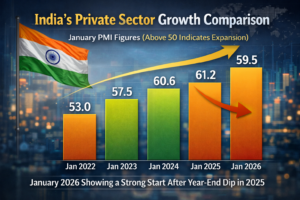
The latest HSBC Flash India Composite Purchasing Managers’ Index (PMI)—a key barometer of economic activity—rose to 59.5 in January, up from 57.8 in December. Any reading above 50 signals expansion, and India’s latest number clearly points to strong and broad-based growth across the economy.
This improvement is especially notable because December had marked an 11-month low. The rebound suggests that the slowdown was temporary and that businesses have entered 2026 with renewed confidence and energy.
What the PMI Tells Us
The PMI captures the mood on the ground by surveying purchasing managers across industries. It tracks crucial aspects of business activity such as new orders, production levels, employment trends, supplier deliveries, and inventories.
When the PMI rises, it usually means companies are seeing more demand, increasing output, and planning for growth. January’s strong reading reflects exactly that—a healthier business environment and improving optimism among Indian firms.
Manufacturing and Services: Growth Across the Board
The rebound was not limited to one sector. Both manufacturing and services showed solid improvement, underlining the breadth of the recovery.
The manufacturing sector performed better in January, with its PMI rising to 56.8, up from 55.0 in December—its strongest level since October 2025. Factories reported faster output growth, driven by stronger demand, rising new orders, and improved operating conditions. Many manufacturers also stepped up spending on raw materials to meet increasing demand.
At the same time, the services sector, which forms the backbone of India’s economy, also gained strength. The services PMI climbed to 59.3 from 58.0, reflecting robust activity in areas such as finance, transport, hospitality, trade, and business services. Since services employ millions of people and contribute the largest share to GDP, their continued expansion is a vital sign of economic stability.
What’s Driving the Rebound?
Several factors came together to power January’s growth.
First and foremost was stronger demand. Companies reported a noticeable increase in new orders, both from within the country and from overseas markets. Domestic demand, supported by better consumer confidence and spending, played a particularly important role in lifting activity after December’s slowdown.
Export demand also picked up. Despite global trade uncertainties and tariff pressures in some markets, Indian exporters saw their strongest growth in new export orders in four months. This suggests that Indian businesses are finding fresh opportunities abroad and strengthening their global presence.
Hiring also showed signs of life. After stagnating in December, employment growth resumed in January, albeit at a moderate pace. Even this cautious increase is significant, as it indicates that companies are preparing for higher workloads and future expansion.
Rising Costs, But Within Control
The PMI survey did flag one area of concern—input costs. Prices for raw materials and services rose at the fastest pace in four months, particularly in the services sector. Higher transport, energy, and operational costs pushed some firms to raise their selling prices slightly.
However, inflationary pressures remain manageable by historical standards, and businesses appear confident that they can navigate these challenges without derailing growth.
Confidence Makes a Comeback
Perhaps the most positive takeaway from the January data is the rise in business confidence, which reached a three-month high. Companies expressed optimism about future demand, efficiency gains, and market opportunities.
This renewed confidence matters. When businesses feel optimistic, they are more likely to invest, hire, and expand operations, creating a positive ripple effect across the economy.
Why This Matters for India
The January rebound sends a reassuring signal about India’s economic resilience. A strong private sector supports GDP growth, strengthens employment prospects, and helps cushion the economy against global uncertainties such as geopolitical tensions or trade disruptions.
The timing is also important. The data comes just days ahead of the Union Budget on February 1, 2026, when the government will outline its fiscal and growth strategy. Strong PMI numbers could encourage policymakers to continue focusing on demand support, investment incentives, and business-friendly reforms.
On the global stage, India’s performance stands out. While several advanced economies are experiencing slower growth or softening demand, India remains one of the fastest-growing major economies, reinforcing its appeal to international investors.