








When Two Giants Finally Shake Hands: How the India–EU Trade Deal Touches Everyday Lives
For nearly twenty years, the idea of a free trade agreement between India and the European Union sat quietly in meeting rooms, policy papers, and diplomatic speeches — always discussed, never quite completed. Generations changed, governments came and went, economies rose and fell. And yet, the deal remained unfinished.
Until now.
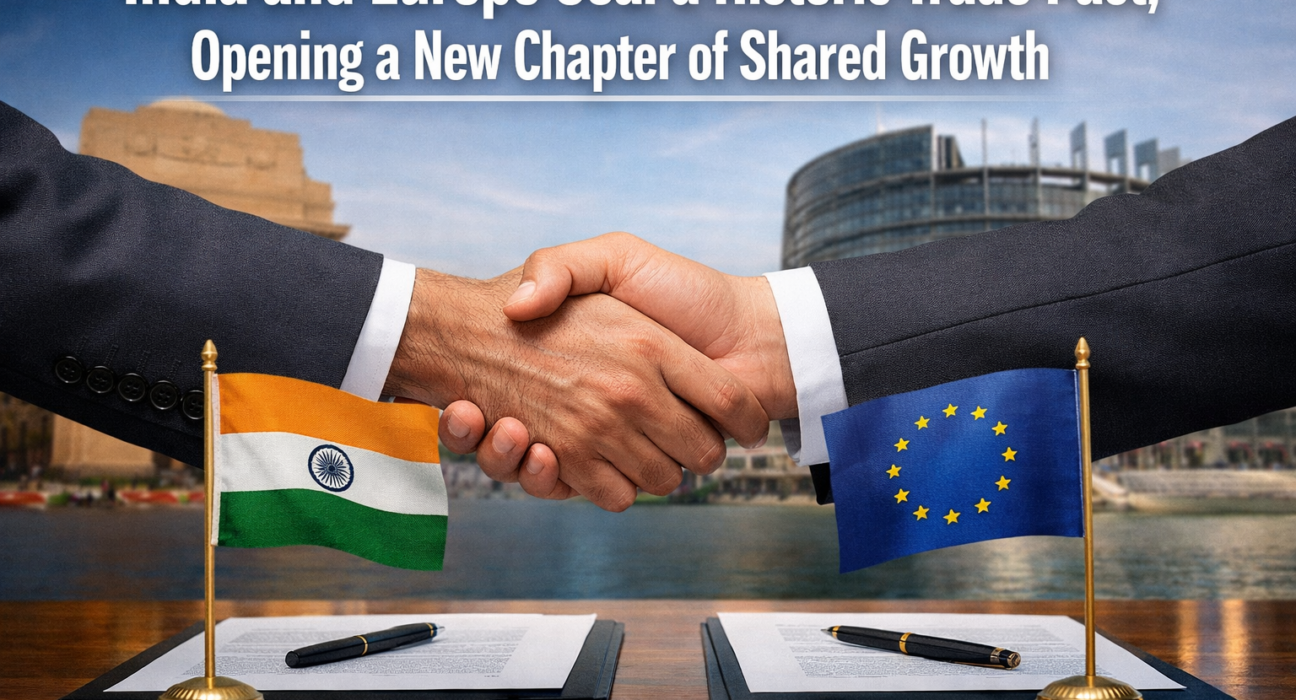
This week, India and the European Union finally did something historic: they closed the gap, shook hands, and finalized what many leaders are calling the “mother of all trade deals.” On paper, it’s about tariffs, services, standards, and mobility. But in real life, it’s about people — workers, students, farmers, entrepreneurs, and families — whose worlds are about to get a little bigger.
A Deal That Took Its Time
Trade negotiations are rarely dramatic, but this one carried the weight of patience. Talks began in the mid-2000s, stalled repeatedly, and were revived with renewed urgency in the post-pandemic world. Global supply chains had fractured, geopolitics had shifted, and countries everywhere were rethinking who they trade with — and how deeply.
For India, the EU is already one of its largest trading partners. For Europe, India represents scale, youth, innovation, and growth. The logic was always there. What was missing was alignment. This agreement finally bridges that gap.
What Changes — Beyond the Headlines
At its heart, the deal reduces trade barriers. That sounds technical, but imagine what it means on the ground.
For an Indian textile worker in Tiruppur, it could mean more stable export orders from Europe as tariffs fall. For a small auto-component manufacturer in Pune, it could open doors to European supply chains that were once too expensive to access. For a farmer growing spices or organic produce, it could mean simpler entry into European markets that value quality and traceability.
On the other side, European companies gain smoother access to one of the world’s fastest-growing consumer markets. Cleaner technologies, precision machinery, sustainable products — many of these are areas where Europe excels and India needs scale. This is not a one-way street. It’s a long bridge with traffic flowing both ways.
The Quiet Power of Opportunity
Perhaps the most human part of the agreement lies in services and skilled mobility. The deal strengthens cooperation in IT, healthcare, research, engineering, and professional services — areas where Indian talent already has a strong global reputation.
For young professionals, this means clearer pathways to work, collaborate, and innovate across borders. A software engineer in Bengaluru, a researcher in Delhi, or a healthcare specialist in Kochi may now find it easier to contribute to European projects without navigating endless red tape.
At the same time, European students and professionals gain access to India’s expanding innovation ecosystem — from startups to research hubs to manufacturing clusters. In a world that often feels divided, this agreement quietly says: let skills travel, let ideas move, let people grow.
Markets React, but Lives Respond
Financial markets reacted quickly, as they usually do. Export-oriented stocks rose. Currency sentiment improved. Headlines spoke of confidence. But the deeper impact will unfold slowly — in factories ramping up production, in startups signing new contracts, in logistics companies hiring more hands, and in families seeing steadier incomes. Trade deals don’t change lives overnight. They create conditions where better futures become possible.
A Signal to the World
This agreement also sends a powerful message beyond India and Europe. At a time when protectionism is rising and global cooperation feels fragile, two major democracies chose dialogue over delay. It shows that large, complex economies can still find common ground — not by lowering standards, but by aligning them. Sustainability, labour rights, environmental responsibility, and transparency all feature strongly in the deal, setting a benchmark for future agreements. In simple terms: growth doesn’t have to come at the cost of values.
Why This Moment Matters
For India, the timing is significant. The country is positioning itself as a global manufacturing hub, a digital powerhouse, and a talent destination. This deal strengthens that vision and adds credibility to India’s long-term growth story. For the European Union, it diversifies partnerships and deepens ties with a nation that will shape the global economy for decades to come. And for ordinary citizens, it offers something less visible but deeply important — stability. In uncertain times, stability is a form of hope.