








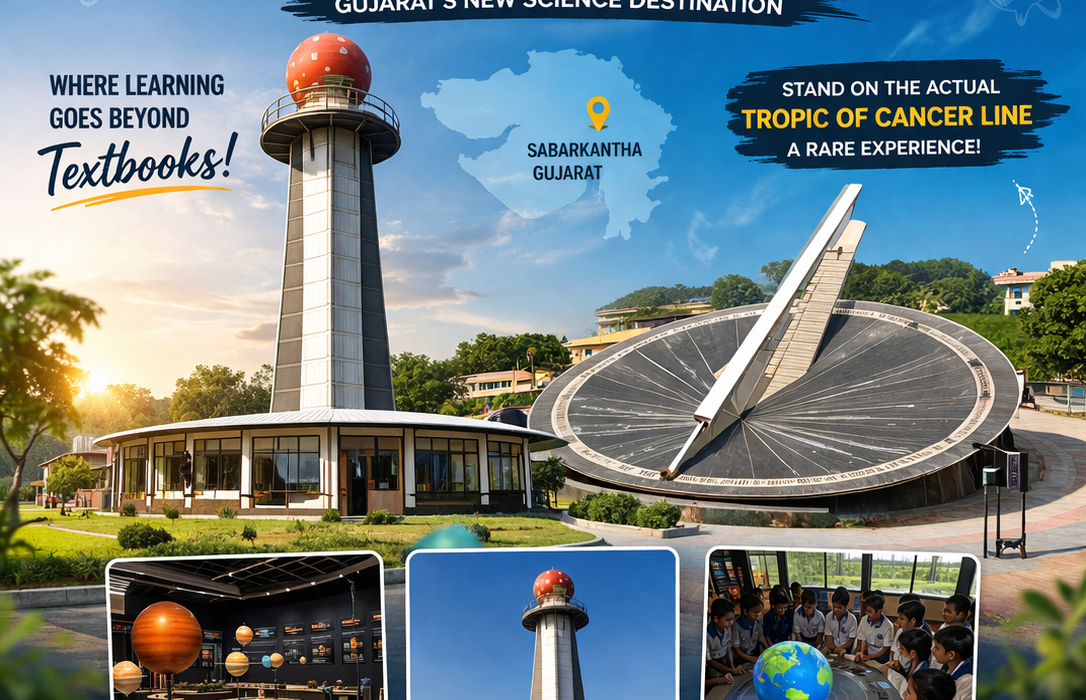
India’s growing focus on education, innovation, and scientific awareness is clearly visible through initiatives that aim to make learning more practical and engaging. One such remarkable development is the Tropic of Cancer Science Park, recently inaugurated in Gujarat. This unique project represents a perfect blend of education, tourism, and real-world scientific understanding, making it a valuable addition to the country’s learning infrastructure.
Located near Salal village in the Sabarkantha district of Gujarat
The science park is built exactly along the Tropic of Cancer—one of the most important lines of latitude on Earth. This line marks the northernmost point where the sun appears directly overhead at noon during the summer solstice. While this concept is often taught in textbooks, the park transforms it into a tangible and interactive experience. Visitors can physically stand on this geographical line, making learning both memorable and meaningful.
The science park was developed by the Gujarat government with the aim of promoting scientific thinking and curiosity among people, especially students. In today’s fast-changing world, where science and technology play a crucial role in shaping the future, such initiatives are essential to inspire the younger generation. By turning complex theories into real-life experiences, the park helps bridge the gap between classroom learning and practical understanding.
Spread across a well-planned area, the park features a variety of installations and attractions designed to simplify scientific concepts. One of its most striking features is the tall tower that marks the exact position of the Tropic of Cancer. This structure not only serves as a visual landmark but also helps visitors understand the significance of the Earth’s tilt and its relationship with the sun.
Another key attraction is the large sundial installed within the park. The sundial demonstrates how time can be measured using the position of the sun’s shadow. This simple yet powerful concept allows visitors to connect with ancient methods of timekeeping while understanding the science behind it. Such exhibits highlight how science has always been a part of everyday life, even before the advent of modern technology.
In addition to these outdoor installations, the park includes exhibition areas that cover various fields such as geography, astronomy, physics, and environmental science. These exhibits explain important topics like the Earth–Sun relationship, seasonal changes, and climate patterns. Through interactive models and visual displays, visitors can explore how the movement of the Earth affects day and night, weather, and different seasons across the globe.
One of the most important aspects of the Tropic of Cancer Science Park is its focus on experiential learning. Instead of simply reading or memorizing information, visitors are encouraged to observe, interact, and understand concepts through hands-on experiences. This method of learning is especially beneficial for students, as it enhances curiosity, improves retention, and makes education more enjoyable.
The park is also expected to play a significant role in promoting science tourism in Gujarat. Its strategic location along a major highway makes it easily accessible for visitors from different regions. Schools and colleges are likely to organize educational trips to the park, giving students an opportunity to learn outside the traditional classroom environment. This not only enriches their academic knowledge but also encourages them to explore and question the world around them.
why the tropic of cancer science part matters for India
The park contributes to a larger vision of building a scientifically aware society. In an age where misinformation can spread easily, fostering a strong foundation in scientific thinking is more important than ever. Initiatives like this help people understand the importance of evidence, observation, and logical reasoning.
Moreover, the development of such infrastructure reflects Gujarat’s commitment to innovation and progress. By investing in projects that combine education with public engagement, the state is setting an example for others to follow. It shows that learning does not have to be limited to books and classrooms—it can be experienced in open spaces, through interaction, and with a sense of curiosity.
The Tropic of Cancer Science Park also aligns with India’s broader educational goals, which emphasize skill-based and practical learning. As the country continues to modernize its education system, projects like this play a crucial role in making learning more relevant and impactful.
In conclusion, the Tropic of Cancer Science Park is more than just a tourist destination; it is a symbol of how education can be transformed through innovation and creativity. By bringing scientific concepts to life, it encourages people to see the world from a new perspective. It inspires curiosity, promotes understanding, and helps build a generation that is not only knowledgeable but also capable of thinking critically and creatively.
As more people visit and experience this unique park, it is likely to leave a lasting impact on their understanding of science and the world around them. In many ways, it represents a step forward in India’s journey toward becoming a knowledge-driven and future-ready nation.