








Jantar Mantar Protest Ends with Education Minister’s Resignation, Marking a Victory for Democratic Dialogue
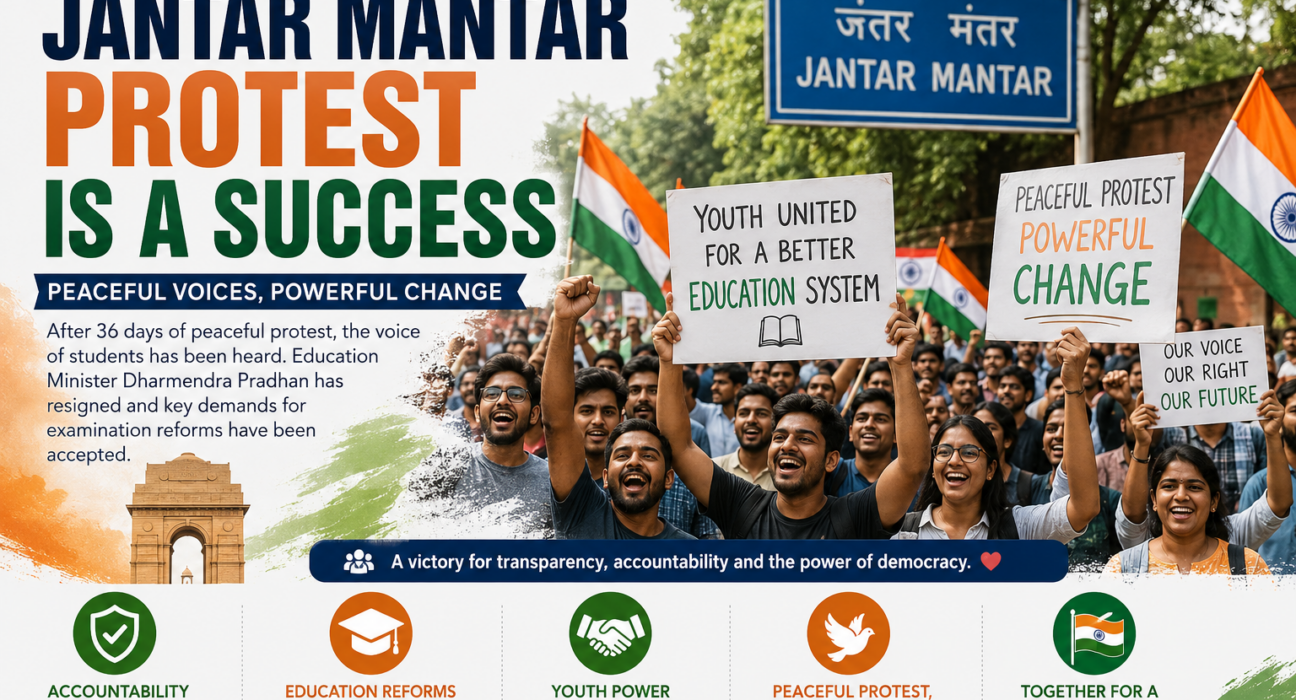
After more than a month of peaceful demonstrations, thousands of young protesters gathered at New Delhi’s Jantar Mantar celebrated what they described as a significant victory for democratic participation. The protests, led by the youth-driven Cockroach Janta Party (CJP) movement, came to an end after Union Education Minister Dharmendra Pradhan resigned, prompting organizers to officially conclude their sit-in and call off further demonstrations.
The movement began in response to widespread public anger over the NEET examination paper leak and broader concerns about transparency in India’s education system. What started as an online satirical campaign gradually evolved into a nationwide youth movement, bringing together students, parents, teachers, and supporters from across the country. Over the course of 36 days, Jantar Mantar became the center of peaceful demonstrations calling for accountability and meaningful reforms.
A Peaceful Movement Reaches Its Goal
When news of the minister’s resignation was announced, celebrations broke out at the protest site. Demonstrators waved the Indian flag, distributed sweets, embraced one another, and described the moment as proof that peaceful civic participation can influence public decisions.
Protest leaders declared that their primary demand had been met and announced the end of the agitation. Roads around Jantar Mantar gradually reopened, normal public movement resumed, and many volunteers helped clean the protest area before leaving, bringing the demonstrations to a peaceful conclusion.
A Strong Voice from India’s Youth
One of the most remarkable aspects of the movement was the active participation of young people.
Students from different states, educational backgrounds, and professions united around a shared concern for transparency and fairness in examinations. Social media also played an important role by helping organizers coordinate events, share updates, and encourage peaceful participation.
The protests demonstrated how digital platforms can amplify civic engagement while allowing young citizens to participate constructively in democratic discussions. Analysts noted that the movement reflected a generation increasingly willing to engage with public policy through peaceful and organized action.
Government Responds with Reform Measures
Alongside the resignation, the government announced steps aimed at strengthening confidence in the education system.
Prime Minister Narendra Modi announced the formation of a high-level examination reform task force, chaired by Infosys co-founder Nandan Nilekani, to recommend improvements in the conduct, security, and transparency of national examinations. The initiative aims to reduce the risk of future paper leaks and improve public trust in competitive exams.
The announcement was welcomed by many education experts as an opportunity to modernize examination systems through technology, stronger safeguards, and better oversight.
A Balanced Perspective
While the conclusion of the protest represents an important milestone, many participants and experts agree that it is only the beginning of a larger process.
The resignation addresses one of the movement’s immediate demands, but long-term success will depend on how effectively the promised reforms are implemented. Improving examination security, strengthening institutional accountability, and rebuilding public confidence will require sustained effort from policymakers, educational institutions, and regulatory authorities.
The movement has therefore shifted from demanding action to monitoring whether promised reforms become reality.
Why This Matters
The events at Jantar Mantar offer an encouraging example of democratic engagement.
Rather than ending in prolonged confrontation, the movement concluded through political accountability and dialogue. It demonstrated that peaceful protests, public participation, and constructive civic action remain important features of a healthy democracy.
The protests also highlighted the growing role of India’s youth in shaping conversations about education, governance, and public policy. Their participation showed that democratic institutions become stronger when citizens actively engage in issues that directly affect their future.
Equally important was the peaceful conclusion of the demonstrations. Once their principal demand had been fulfilled, protest leaders encouraged participants to disperse responsibly, allowing normal life to resume in the capital.
Looking Ahead
The conclusion of the Jantar Mantar protests is being remembered not only for a ministerial resignation but also for what it symbolizes: the importance of accountability, peaceful participation, and dialogue in a democracy.
As India moves forward with examination reforms, attention will now focus on the work of the newly announced task force and the implementation of stronger systems to protect the integrity of national examinations.
For many young Indians, the outcome serves as a reminder that peaceful civic engagement can contribute to meaningful public discussion. While challenges remain, the events at Jantar Mantar have opened an opportunity for reforms that could strengthen the education system and restore confidence among millions of students preparing for competitive examinations in the years ahead.
Read more positive news from India.
Visit the Ministry of Education