

Cultural Mindfulness in a Fast World: Why Ancient Traditions Still Matter Today

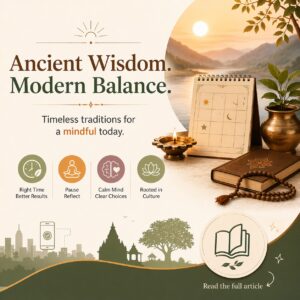
Cultural Mindfulness is becoming increasingly relevant in today’s fast world. In today’s fast-paced digital world, where everything is driven by speed, efficiency, and instant results, it’s easy to assume that traditional practices are slowly fading away. With smartphones in our hands and artificial intelligence shaping how we work and think, modern life often feels disconnected from the past.
But quietly, and almost unexpectedly, something different is happening.
Across India, millions of people continue to follow ancient systems like the Panchang to guide their daily lives. From choosing the right time to start a new project to planning important life events, these traditions are not just surviving — they are evolving alongside modern life.
And that, in itself, is a powerful and positive sign.
Cultural Mindfulness in a Fast-Paced World
Modern life is built on urgency. Deadlines, notifications, and constant updates have created a culture where everything needs to happen now. In contrast, traditional practices like Panchang encourage something very different — patience, awareness, and timing.
The idea of selecting a Shubh Muhurat (auspicious time) is not just about astrology. It reflects a deeper mindset: that not everything should be rushed, and that timing plays an important role in success and well-being.
In a way, this approach brings balance. While technology pushes us forward, tradition reminds us to pause.
The Balance Between Speed and Stillness
For many people, following cultural practices is not just about belief; it’s about mental clarity and emotional comfort.
In uncertain times, routines and traditions provide a sense of structure. Checking the Panchang or aligning activities with certain timings can create a feeling of control in an otherwise unpredictable world
In uncertain times, routines and traditions provide a sense of structure, and you can explore simple mindful living practices to bring more balance into your daily routine.
This is especially relevant today, where stress and anxiety are becoming increasingly common. While modern solutions focus on productivity and performance, traditional systems often emphasize harmony and alignment.
And sometimes, that’s exactly what people need.
Tradition in the Digital Age
What makes this trend even more interesting is how seamlessly tradition has adapted to technology.
Today, Panchang is no longer limited to printed calendars or priests. It is available through:
- Mobile apps
- Websites
- Daily notifications
This means that even younger generations, who are deeply connected to digital platforms, are engaging with these traditions in new ways.
If you’re curious to understand it better, you can learn more about how Panchang works in everyday life.
Technology, instead of replacing culture, is actually helping preserve and spread it.
🇮🇳 A Reflection of Cultural Identity
India has always been known for its deep-rooted traditions and cultural diversity. Practices like Panchang are not just tools for decision-making — they are a reflection of identity.
In a globalized world, where cultures often blend and boundaries become less defined, maintaining a connection to one’s roots becomes even more important.
By continuing these practices, people are not just following rituals; they are preserving a sense of belonging.
Not About Right or Wrong — But About Meaning
It’s important to understand that the value of such traditions is not always about whether they are scientifically proven or universally accepted.
Instead, their importance lies in the meaning they bring to people’s lives.
For some, it’s faith.
For others, it’s habit.
And for many, it’s simply a way to stay connected to something bigger than themselves.
In a world that often feels chaotic and overwhelming, having something that provides meaning — even in small ways — can make a significant difference.
Cultural Mindfulness and Mental Clarity
Practicing Cultural Mindfulness allows individuals to stay calm and focused. Interestingly, practices like following auspicious timings can also be seen as a form of mindfulness.
They encourage people to:
- Be aware of time
- Think before acting
- Approach decisions with intention
This is very similar to modern mindfulness practices, which emphasize presence and conscious living.
The difference is that these ideas have been part of cultural traditions for centuries.
Why This Matters Today
At a time when the world is rapidly changing, the ability to hold on to meaningful traditions is a sign of resilience.
It shows that progress does not always mean letting go of the past. Instead, it can mean integrating the old with the new.
This coexistence of tradition and technology creates a more balanced way of living — one that values both innovation and heritage.
Conclusion
Cultural Mindfulness helps us stay grounded while embracing modern life. While the world continues to move faster with each passing day, traditions like Panchang quietly remind us of something important: not everything needs to be rushed.
In the middle of constant change, they offer stability.
In the noise of modern life, they provide clarity.
And in a world focused on the future, they keep us connected to our roots.
Cultural Mindfulness is not just a tradition but a way of living.
Because sometimes, the most meaningful progress is not about moving forward faster —
but about staying grounded while we do.mindful living practices
To go deeper, you can also explore Indian traditions in modern life and how they continue to shape our daily choices.
Many people today are learning what is mindfulness to reduce stress. what is mindfulness