


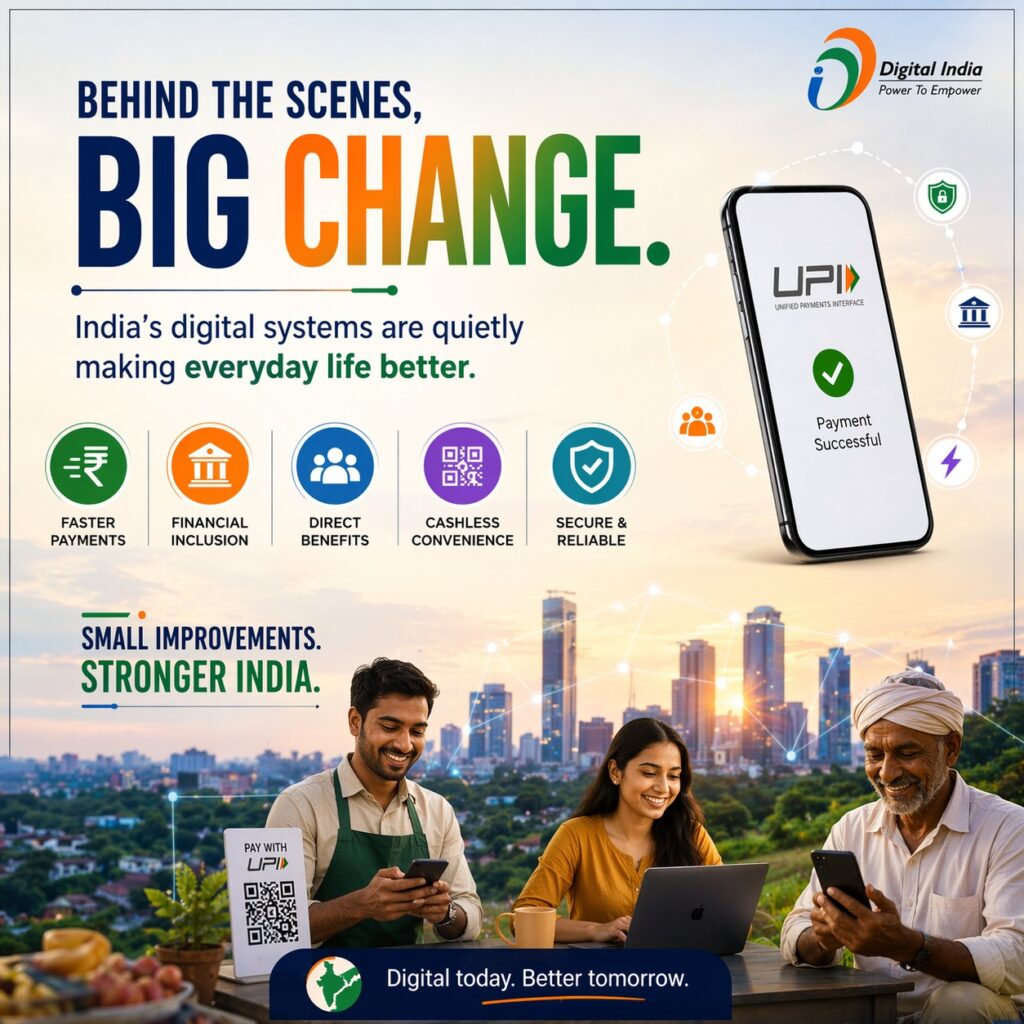
The Silent Upgrade: How India’s Digital Infrastructure Is Quietly Improving Everyday Life
India digital infrastructure is quietly transforming how people live and work today. In a world dominated by breaking news, viral headlines, and constant updates, it’s easy to believe that the most important changes are always the loudest ones. But sometimes, the most meaningful progress happens quietly — in the background, without trending hashtags or daily discussions.
India’s digital systems are improving rapidly.
Learn more about Digital India initiatives on the official website.
Across India, a silent transformation is taking place. It’s not about political debates or major announcements. It’s about something far more practical: the steady improvement of digital infrastructure that millions of people rely on every day.
And the surprising part? Most people haven’t even noticed it.
How India Digital Infrastructure Is Changing Daily Life
Over the past few years, India has built one of the most advanced digital public systems in the world. Initiatives under Digital India have created a foundation where services like payments, identification, and banking are increasingly connected and accessible.
At the heart of this ecosystem is National Payments Corporation of India, which manages platforms like UPI.
UPI has transformed digital payments in India.
Read more about how UPI works through NPCI’s official platform.
Initially, these systems were seen as innovations. Today, they are becoming something even more powerful — invisible utilities.
When you scan a QR code and pay instantly, you don’t think about the system behind it. When money transfers in seconds, there’s no second thought. This lack of attention isn’t a flaw — it’s a sign of success.
Because when a system works so smoothly that people stop noticing it, it has truly become part of everyday life.
You can also read our article on modern lifestyle changes to understand how technology is shaping everyday life.
From Friction to Flow
Not long ago, everyday financial activities in India involved friction:
- Long queues at banks
- Delayed transactions
- Cash dependency
- Middlemen in government processes
Today, that friction is slowly disappearing. This growth in India digital infrastructure is improving access for millions.
Digital payments have become faster and more reliable. Government benefits are increasingly reaching people directly. Even small vendors and street sellers are part of a digital ecosystem that was once limited to urban spaces.
This shift from friction to flow is subtle, but it has a profound impact. It saves time, reduces stress, and increases efficiency — not just for individuals, but for the entire system.
Inclusion at Scale
One of the most remarkable aspects of this transformation is its reach.
Digital infrastructure in India is not limited to big cities or tech-savvy users. It extends to rural areas, small businesses, and first-time users of digital services.
A farmer receiving subsidies directly in a bank account.
A street vendor accepting payments through a QR code.
A student paying fees online without visiting an office.
These are not isolated stories. They represent a broader shift toward financial and digital inclusion at scale.
And unlike many global systems, this one is designed to be simple and accessible — making it usable for people across different backgrounds.
Progress Without Noise
In many countries, technological progress is often associated with big announcements, large investments, or visible infrastructure projects.
But in this case, progress looks different.
It’s not about what’s being built — it’s about how smoothly things are working.
- Transactions happening in seconds
- Fewer failures in payment systems
- Better integration between services
These improvements may seem small individually, but collectively, they represent a major upgrade in how systems function.
And yet, because they don’t create dramatic headlines, they often go unnoticed.
A Global Example in the Making
While this transformation may feel normal within India, it is gaining attention globally.
Countries around the world are studying India’s digital systems, particularly UPI, as a model for building scalable, inclusive financial infrastructure.
The idea that a country with such a large and diverse population can create a system that is both efficient and widely accessible is, in itself, a significant achievement.
It shows that technology, when designed thoughtfully, can solve real-world problems at scale.
Rethinking What Progress Looks Like
We often associate progress with visible change — new buildings, new policies, or new technologies.
But this transformation challenges that idea.
Here, progress is not about something new being introduced. It’s about existing systems becoming:
- Faster
- Simpler
- More reliable
It’s about removing barriers rather than adding features.
And in many ways, this kind of progress is more meaningful, because it directly improves everyday experiences.
Why This Matters
In a time when news is often dominated by negativity, conflict, and uncertainty, this kind of development offers a different perspective.
It shows that:
- Systems can improve over time
- Technology can simplify life rather than complicate it
- Large-scale change doesn’t always need to be loud
Most importantly, it highlights the importance of consistent, incremental progress.
Conclusion
The future of India digital infrastructure looks more efficient and inclusive. The evolution of India’s digital infrastructure is not a headline-driven story. It’s a slow, steady process that is reshaping how millions of people interact with money, services, and institutions.
It’s the kind of change that doesn’t demand attention — but deserves it.
Because in the end, real progress is not always about big moments.
Sometimes, it’s about small improvements happening every day, quietly making life better.
And when those improvements become so seamless that people stop noticing them —
that’s when you know something truly meaningful has been built.