









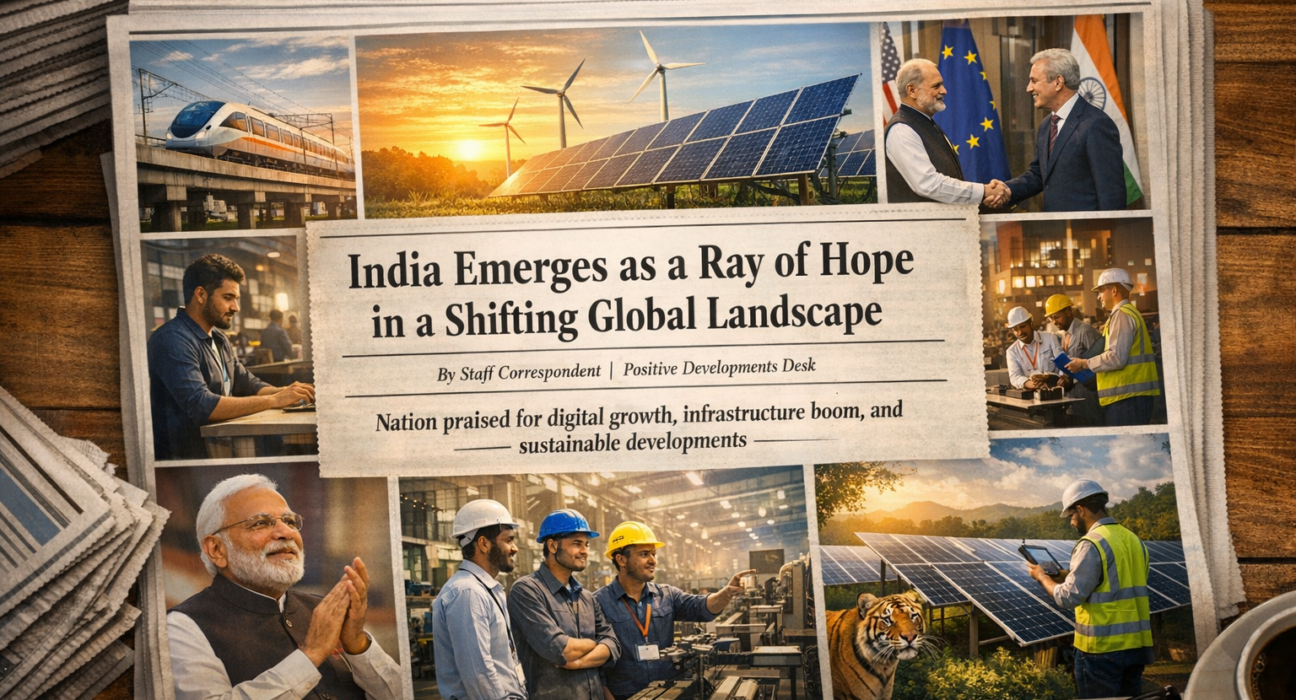
India’s rapid grow in supply chain and technology
At a time when much of the world is navigating economic uncertainty, supply chain shifts, and rapid technological change, India is increasingly being viewed as a bright and steady force on the global stage. Recent national discussions and international reactions have highlighted India as a “ray of hope” not just as a fast-growing economy, but as a country building long-term strength through digital innovation, infrastructure expansion, youth-driven entrepreneurship, and sustainable growth.
This growing optimism is not based on a single announcement or event. Instead, it reflects a broader pattern of steady progress across multiple sectors that together paint a reassuring picture of forward momentum.
India’s economic resilience has been one of the strongest foundations behind this positive outlook. While several major economies have experienced uneven recoveries and slowed growth, India has continued to demonstrate relative stability and expansion. Domestic demand remains active, public investment is rising, and private sector confidence is gradually strengthening. Economists note that diversified growth driven by services, manufacturing, startups, and consumption has helped cushion the economy against global shocks.
A key driver behind this resilience is India’s rapidly advancing digital ecosystem. Over the past few years, digital public infrastructure has transformed how citizens and businesses interact with money and services. From instant mobile payments in neighborhood shops to online government platforms that reduce paperwork and delays, technology is making daily transactions faster and more transparent. Financial inclusion has expanded as more citizens and small enterprises enter the formal economy through digital tools. Global policy observers increasingly point to India’s digital model as an example of scalable, inclusive innovation.
India’s development in different industry
Infrastructure development is adding further strength to this growth story. Large-scale projects in highways, railways, logistics networks, airports, and energy are reshaping connectivity across regions. These investments are not only generating employment but also lowering long-term transportation and operating costs for businesses. Improved infrastructure helps industries move goods faster, farmers reach markets more efficiently, and smaller cities attract new investment. Analysts describe this as a multiplier effect when infrastructure improves, economic activity tends to accelerate around it.
India’s manufacturing sector is also gaining renewed attention. With global companies seeking to diversify production bases, India is emerging as an attractive destination. Incentive programs and policy support have encouraged investment in electronics, pharmaceuticals, renewable energy components, and specialty manufacturing. Industry experts say this shift supports job creation while also strengthening supply chain resilience. The move toward higher-value manufacturing marks an important step in expanding India’s economic capabilities beyond traditional strengths.
Equally noteworthy is the continued rise of India’s startup ecosystem. The country remains one of the world’s most active startup hubs, with new ventures emerging across fintech, health technology, education platforms, climate solutions, and artificial intelligence. What sets the current phase apart is geographic spread innovation is no longer limited to major metropolitan areas. Smaller cities are producing founders and technology talent, broadening the innovation base. Investors view this as a sign of deepening entrepreneurial culture and long-term competitiveness.
India being eco-friendly and non polluting
Clean energy and sustainability efforts are adding another positive dimension. India has been expanding its renewable energy capacity, especially solar power, while also promoting electric mobility and green hydrogen initiatives. Energy transition programs aim to balance development needs with environmental responsibility. Climate experts note that when a large developing economy advances clean energy at scale, it creates both domestic and global benefits. It demonstrates that growth and sustainability can progress together rather than in conflict.
India’s strengthening international partnerships are further reinforcing its positive image. Diplomatic and economic cooperation with multiple regions has expanded, covering trade, technology, defense, and climate collaboration. Global leaders have increasingly described India as a stabilizing partner and an important contributor to future global growth. Rising foreign investment interest and cross-border technology partnerships reflect growing trust in India’s long-term direction.
Demographics also play a crucial role in the optimism surrounding India’s future. With one of the world’s youngest populations, the country holds a significant human capital advantage. Skill development initiatives, digital education, and vocational training programs are working to prepare young people for emerging industries. Workforce experts emphasize that a skilled young population can drive productivity, innovation, and entrepreneurship for decades if properly supported.