


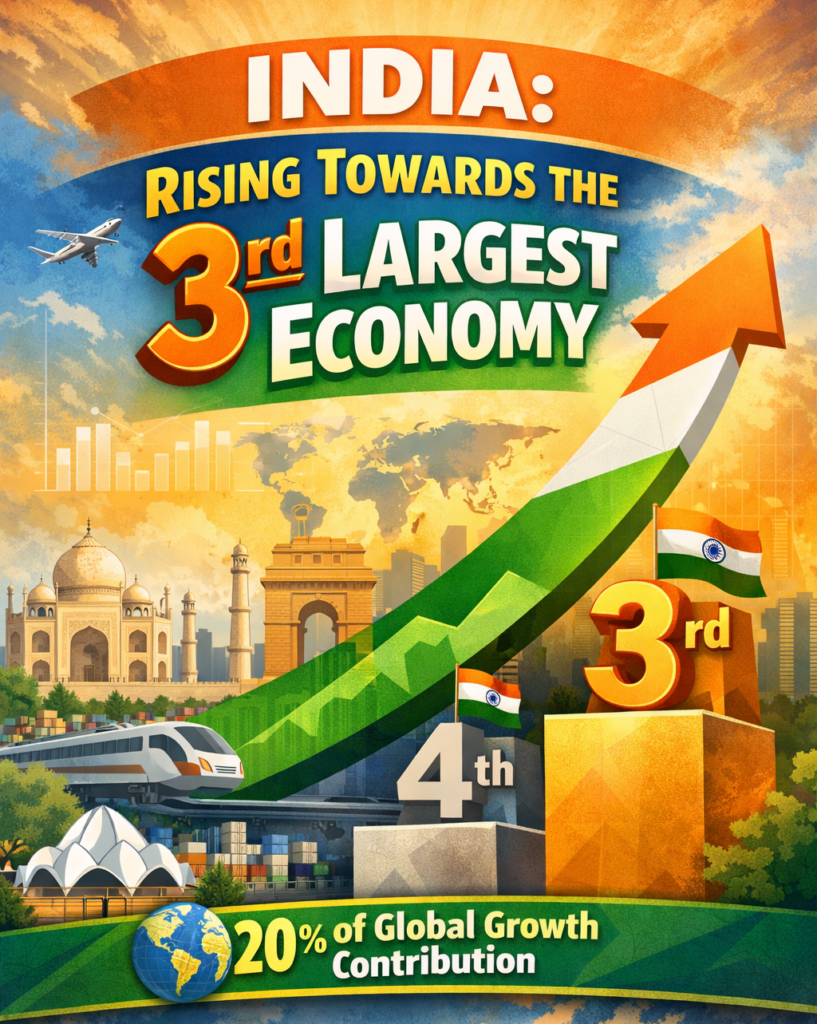
India’s Economic Growth: A Story of Momentum and Promise
In recent weeks, India has grabbed global headlines not for challenges, but for its remarkable economy momentum and a future that seems brighter than ever. At a major international forum, Prime Minister Narendra Modi highlighted a fact that’s rare for any large economy: India is currently the fastest-growing major economy in the world. Experts cited at the event project that India’s economy will soon contribute around 20% of global economic growth — a remarkable share that underscores just how pivotal India is becoming on the world stage. Let’s unpack what that really means, why it’s happening, and what it could mean for everyday lives across the country.
From Rising Star to Global Powerhouse
A Decade of Growth:
Over the past decade, India’s economy has been steadily accelerating. It wasn’t long ago that India was comfortably positioned outside the top few economies in the world. But strong growth over recent years has changed that narrative.
• Today, India surpassed Japan to become the world’s fourth-largest economy, based on nominal GDP figures a significant milestone in its economic journey.
• Government projections and economic analyses suggest that within the next few years, India is well-positioned to overtake Germany and become the world’s third largest economy.
This shift is more than symbolic. It reflects decades of reforms, private investment, and supportive policies aimed at strengthening the country’s economic foundations.
Why This Growth Is Happening
1. Rapid GDP Expansion:
India’s GDP growth rates have been consistently among the highest globally. For multiple quarters, GDP growth has remained strong significantly above the world average even when other major economies struggled with slowdowns due to global headwinds and trade tensions.
This growth reflects not just one sector, but across manufacturing, services, technology, and infrastructure. Domestic demand from both cities and rural areas has been a powerful engine of economic activity.
2. Macro-Economic Stability
India’s economic policymakers have earned praise for maintaining macroeconomic stability meaning inflation, deficits, and debt levels have all been managed responsibly. This stability builds investor confidence, both at home and abroad.
Financial markets are responding positively, and record numbers of retail investors are participating through SIPs (Systematic Investment Plans), indicating growing trust in India’s financial system.
3. Structural Reforms and Investment
Over the past decade, India introduced numerous structural reforms from simplification of taxes to initiatives boosting manufacturing capacity. These reforms have helped improve India’s ease of doing business, attract foreign investment, and create jobs.
The combination of stronger infrastructure and vibrant entrepreneurial activity is helping India capture global capital and talent.
India’s Role in the Global Economy
When we say India’s share of global growth could reach ~20%, it’s important to understand the context.
Global economic growth reflects the combined growth of all countries’ economies. If India contributes around one-fifth of that growth, it means India alone could be responsible for nearly 1 in every 5 dollars added to the world economy in a given year a staggering influence for any single nation.
This also means that many global economic forecasts and investment decisions will increasingly consider India’s performance as a key driver of global trends. India will no longer be a peripheral player it will be one of the core engines of global growth.
The Road Ahead
While projections vary in timing (some suggest 2028 or 2030 for becoming the third largest economy), the broad consensus among economists, financial institutions, and government bodies is that India’s growth trajectory is strong and sustainable.
The journey to this point wasn’t easy, and challenges remain. But achieving such milestones signals that India’s long-term economic strategy is translating into real results not just on paper, but in tangible shifts in global economic rankings.