









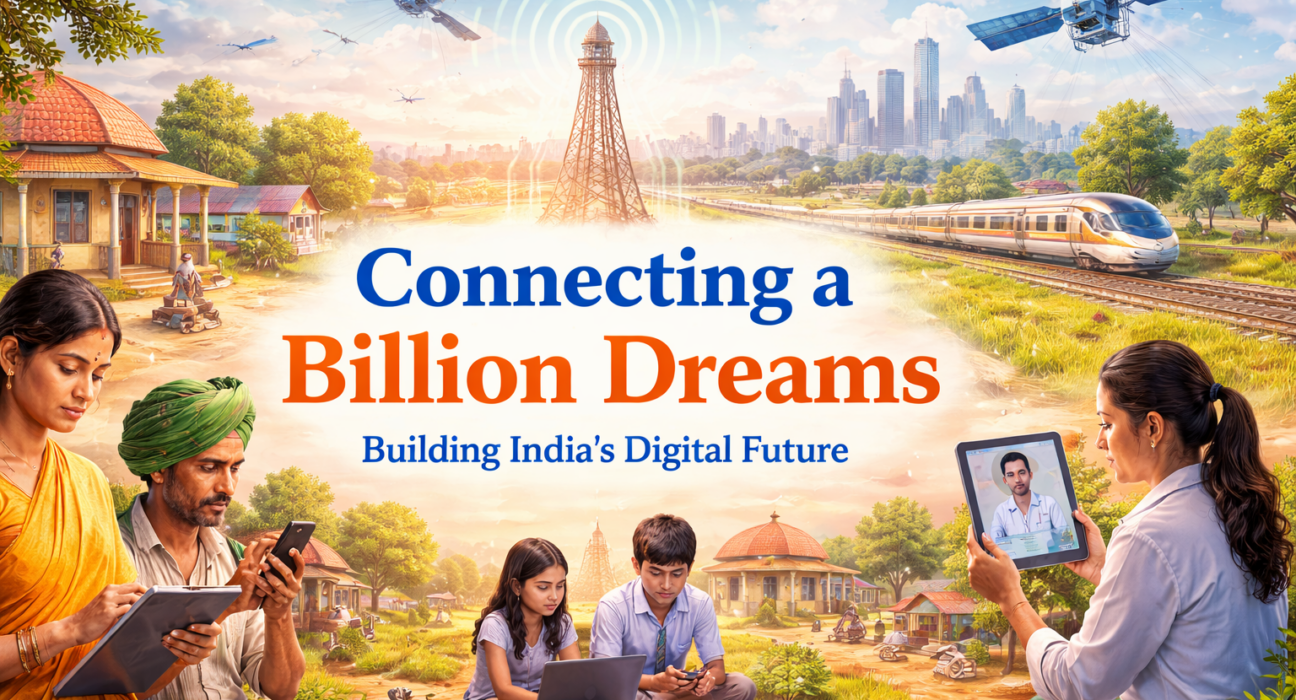
Connecting a Billion Dreams: How India Is Quietly Building a Future-Ready Digital Nation
In a small village miles away from India’s bustling cities, a student attends an online class without buffering for the first time. A farmer checks real-time weather updates before heading to his field. A local health worker books a tele-consultation instead of sending a patient on a long, expensive journey to the district hospital. These are not isolated moments of progress they are signs of a deeper transformation unfolding across the country as India rapidly strengthens its digital and telecom infrastructure.
Over the past few years, India’s digital push has moved far beyond urban skylines and smartphone advertisements. It is now reaching deep into rural heartlands, border areas, islands, and previously disconnected regions. Through a multi-layered strategy that combines expanded 4G coverage, a fast-paced 5G rollout, and secure satellite communication systems, the country is laying the foundation for a future-ready digital ecosystem one designed not just for speed, but for inclusion, resilience, and opportunity.
At the heart of this effort is the belief that connectivity is no longer a luxury. It is a basic enabler of education, healthcare, livelihoods, and governance. Programmes like BharatNet are playing a critical role in this shift. By extending high-speed optical fibre networks to lakhs of gram panchayats, BharatNet is bridging the digital divide that once separated villages from cities. For millions of rural households, reliable internet access now means access to government services, digital payments, online learning platforms, and new income opportunities.
Powerfull Pillars For Connection
Parallel to this rural broadband push is India’s aggressive expansion of mobile networks. While 4G continues to be strengthened to ensure reliable coverage across the country, the rollout of 5G is opening doors to technologies that were once considered futuristic. From smart agriculture and remote surgery to real-time traffic management and advanced manufacturing, 5G is expected to power innovations that could redefine how Indians live and work. Importantly, the focus is not just on metro cities telecom providers are steadily extending next-generation connectivity to tier-2 and tier-3 towns, ensuring that technological growth does not remain geographically concentrated.
Another powerful pillar of this transformation is satellite communication. In a country as vast and geographically diverse as India, there will always be regions where laying cables or installing towers is difficult. Secure satellite connectivity offers a solution for remote villages, disaster-prone areas, maritime zones, and border regions. With growing collaboration between telecom agencies and space institutions like ISRO, satellite-based communication is emerging as a reliable backup and expansion layer strengthening national resilience during natural disasters, emergencies, and network disruptions.
Digital Expansion
What makes this digital expansion particularly significant is its human impact. Improved connectivity is changing how people interact with the state and with markets. Farmers are gaining access to digital marketplaces and advisory services. Small entrepreneurs are reaching customers far beyond their localities. Students from modest backgrounds are preparing for competitive exams using online resources once available only in cities. Women-led self-help groups are using digital payments and social media platforms to scale their businesses. Each connection carries the potential to alter a life’s trajectory.
The digital infrastructure push is also making governance more transparent and efficient. With better connectivity, e-governance platforms are becoming more accessible, reducing paperwork, delays, and corruption. Direct Benefit Transfers reach beneficiaries faster. Grievance redressal systems work more smoothly. Public services, from land records to healthcare schemes, are becoming easier to access with just a few taps on a screen.
Equally important is the emphasis on building a secure and resilient network. As India becomes more digitally connected, protecting data, ensuring network reliability, and safeguarding critical infrastructure have become national priorities. Investments in secure communication systems and indigenous technology development reflect an understanding that digital sovereignty is as important as digital speed.
India’s telecom and digital expansion is not just about technology it is about trust, access, and dignity. It is about ensuring that a child in a remote village has the same digital starting point as one in a metropolitan school, and that opportunity is not limited by geography. While challenges remain from last-mile connectivity issues to digital literacy gaps the momentum is undeniable.