








National Girl Child Day: Celebrating Progress, Confronting Challenges, and Reimagining India’s Future
Every year on January 24, India observes National Girl Child Day, a day that goes beyond symbolism to spotlight the rights, dignity, and immense potential of the country’s girls. In 2026, the observance once again served as both a celebration of progress made and a reminder of the work that still lies ahead in achieving true gender equality.
Across cities, towns, and villages, schools, government institutions, non-profits, and community groups came together to mark the day with discussions, awareness campaigns, cultural programmes, and policy reviews. The underlying message was clear: the future of India is inseparable from the future of its girls.
Why National Girl Child Day Matters
National Girl Child Day was first initiated by the Government of India in 2008 to address deep-rooted challenges such as gender discrimination, declining child sex ratio, unequal access to education, early marriage, and health disparities. While India has made measurable strides in many of these areas, the observance remains relevant because social change requires sustained effort, not one-time victories.
In 2026, conversations around the girl child have evolved. Alongside traditional concerns, newer themes such as digital access, mental health, leadership opportunities, STEM education, and safety in public and online spaces have taken centre stage.
Progress Worth Celebrating
There is genuine reason for optimism. Over the past decade, girls’ enrolment in schools has increased significantly, with many states achieving near parity at the primary and secondary levels. Programmes like Beti Bachao Beti Padhao, Samagra Shiksha, and mid-day meal schemes have played a key role in keeping girls in school.
Health indicators have also shown improvement. Institutional deliveries, immunisation coverage, and nutrition awareness among adolescent girls have steadily increased. Schemes focusing on menstrual hygiene have helped reduce stigma and school absenteeism, especially in rural areas.
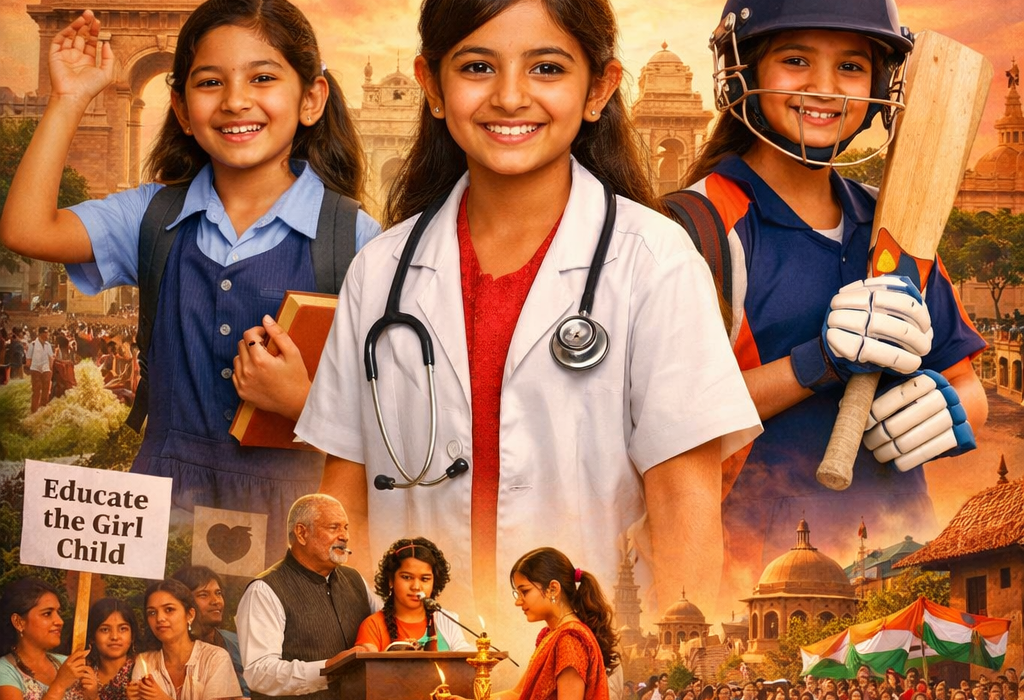
Perhaps the most visible change is in aspiration. From classrooms to sports fields, research labs to startup spaces, Indian girls are increasingly dreaming bigger and stepping into roles once considered out of reach. National Girl Child Day this year celebrated these success stories — not as exceptions, but as signs of a changing social mindset.
Challenges That Still Persist
Despite progress, the reality remains uneven. Early marriage, though declining, still affects many girls, particularly in economically vulnerable communities. Dropout rates increase sharply after secondary school, often due to household responsibilities, safety concerns, or financial constraints.
Gender-based violence, online harassment, and unequal access to digital resources continue to restrict girls’ freedom and confidence. In some regions, traditional attitudes still limit girls’ choices regarding education, career, and marriage.
National Girl Child Day 2026 did not shy away from these uncomfortable truths. Panel discussions and grassroots dialogues focused on the need for community-level change, stressing that laws and schemes must be supported by shifts in social attitudes.
The Role of Education and Empowerment
Education remained the central theme of this year’s observance. Experts emphasised that education is not merely about literacy, but about critical thinking, financial awareness, digital skills, and leadership development.
Special focus was placed on encouraging girls to pursue careers in science, technology, engineering, and mathematics (STEM), as well as sports and entrepreneurship. Mentorship programmes featuring women professionals were highlighted as powerful tools to help girls visualise possibilities beyond traditional roles.
Equally important was the conversation around emotional well-being. Schools and parents were urged to prioritise mental health, self-confidence, and safe spaces for girls to express themselves.
A Collective Responsibility
One of the strongest messages to emerge from National Girl Child Day 2026 was that empowering girls is not solely the responsibility of governments or schools. Families, communities, media, and workplaces all play a vital role.
Parents were encouraged to invest equally in daughters’ education and ambitions. Boys and men were called upon to become allies in building a society rooted in respect and equality. Media platforms were urged to portray girls not just as beneficiaries of welfare, but as leaders, innovators, and change-makers.
Looking Ahead
National Girl Child Day is ultimately about the future — a future where every girl in India can grow up safe, educated, confident, and free to choose her own path. The 2026 observance reaffirmed that while challenges remain, the direction is hopeful.
As India moves forward on its development journey, the empowerment of the girl child will remain one of its strongest foundations. When girls thrive, families prosper, communities strengthen, and the nation advances.
National Girl Child Day is not just a date on the calendar — it is a reminder that investing in girls is investing in India itself.