









Australian of the year
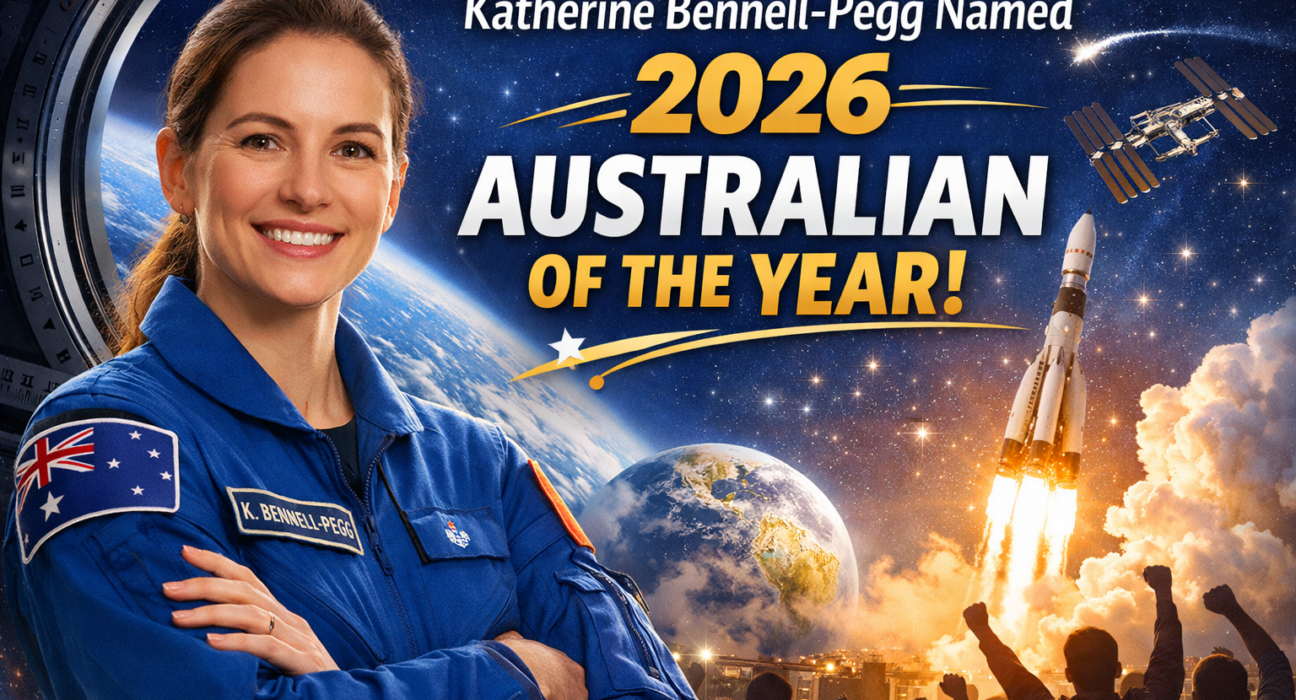
In a moment of national pride and global inspiration, Australian astronaut Katherine Bennell-Pegg has been named Australian of the Year 2026, recognized for her groundbreaking contributions to space exploration and her powerful role in inspiring the next generation of scientists, engineers, and explorers. Her recognition marks not only a personal achievement but also a milestone for Australia’s growing presence in the global space community.
Katherine Bennell-Pegg is widely known as one of the leading figures in Australia’s modern space journey. As a key member of the country’s astronaut corps, she has helped put Australia firmly on the map in international space collaboration. Her work bridges science, technology, policy, and public engagement making space not just a distant dream, but a shared national mission.
What makes her story especially powerful is that her path to space was built not only on technical excellence, but also on persistence and vision. With a background in engineering and space systems, Bennell-Pegg worked across multiple international space programs and agencies before becoming one of the most recognized faces of Australia’s astronaut initiative. Her work has included mission planning, systems design, and international cooperation projects that support safe and sustainable space operations.
Committee Decision and Technical Contribution
The Australian of the Year award committee highlighted two major reasons for her selection: technical contribution and public inspiration. While many astronauts are known mainly within scientific circles, Bennell-Pegg has become a visible ambassador for science education. She regularly speaks with students, universities, and young innovators, encouraging them to pursue careers in STEM science, technology, engineering, and mathematics. Her outreach efforts have reached thousands of young people across cities and regional communities alike.
Teachers and education leaders have praised her impact, noting that student interest in aerospace, robotics, and engineering programs has increased following her public engagement tours and talks. In classrooms, her journey is now used as a modern example of how global careers in space science are becoming more accessible including for students from countries that historically did not send astronauts.
Her recognition also reflects a broader positive shift: space exploration is becoming more international and collaborative. No longer limited to a handful of superpowers, the modern space era includes partnerships between many nations. Australia’s expanding role supported by experts like Bennell-Pegg focuses on satellite technology, Earth observation, deep space communication, and mission support systems. These areas are critical for climate monitoring, disaster response, navigation, and global communications.
Reasons to recieve the award
Another reason her award has drawn praise is her emphasis on the peaceful and practical uses of space. In interviews, Bennell-Pegg has repeatedly stressed that space technology directly benefits life on Earth from weather forecasting and environmental protection to emergency services and agriculture. By connecting space research to everyday human needs, she has helped make the field more relatable and meaningful to the public.
Colleagues describe her as both technically rigorous and deeply approachable a rare combination that makes her effective in both mission rooms and public forums. Fellow researchers note her ability to translate complex aerospace concepts into language that students and non-experts can understand. That communication skill has been central to her influence.
The award announcement ceremony emphasized that role models in science are especially important in today’s fast-changing technological world. With artificial intelligence, space commercialization, and planetary research accelerating rapidly, visible leaders help guide ethical, educational, and cooperative directions. Bennell-Pegg’s recognition sends a message that scientific contribution and public service can go hand in hand.
Young women in STEM fields have also celebrated the announcement. Representation in aerospace and engineering has historically been uneven, and Bennell-Pegg’s recognition provides a high-visibility example of leadership and achievement. Advocacy groups say such recognition helps break stereotypes and expands career imagination for students everywhere.
Public reaction has been overwhelmingly positive. Social media, academic institutions, and science organizations have shared congratulatory messages, calling the award “well deserved” and “forward looking.” Many commentators describe it as a hopeful signal that nations are increasingly valuing scientific advancement, education, and peaceful exploration.
Beyond the title itself, Bennell-Pegg has stated that she hopes the recognition will be used as a platform to further promote science literacy and international cooperation in space missions. She has emphasized that space exploration is not about individual glory, but shared human progress.
In a time when much global news can feel heavy, this recognition stands out as a bright and motivating development celebrating curiosity, knowledge, and the human drive to explore beyond boundaries. It reminds the world that progress is not only measured in technology, but also in the inspiration we pass on to future generations.