


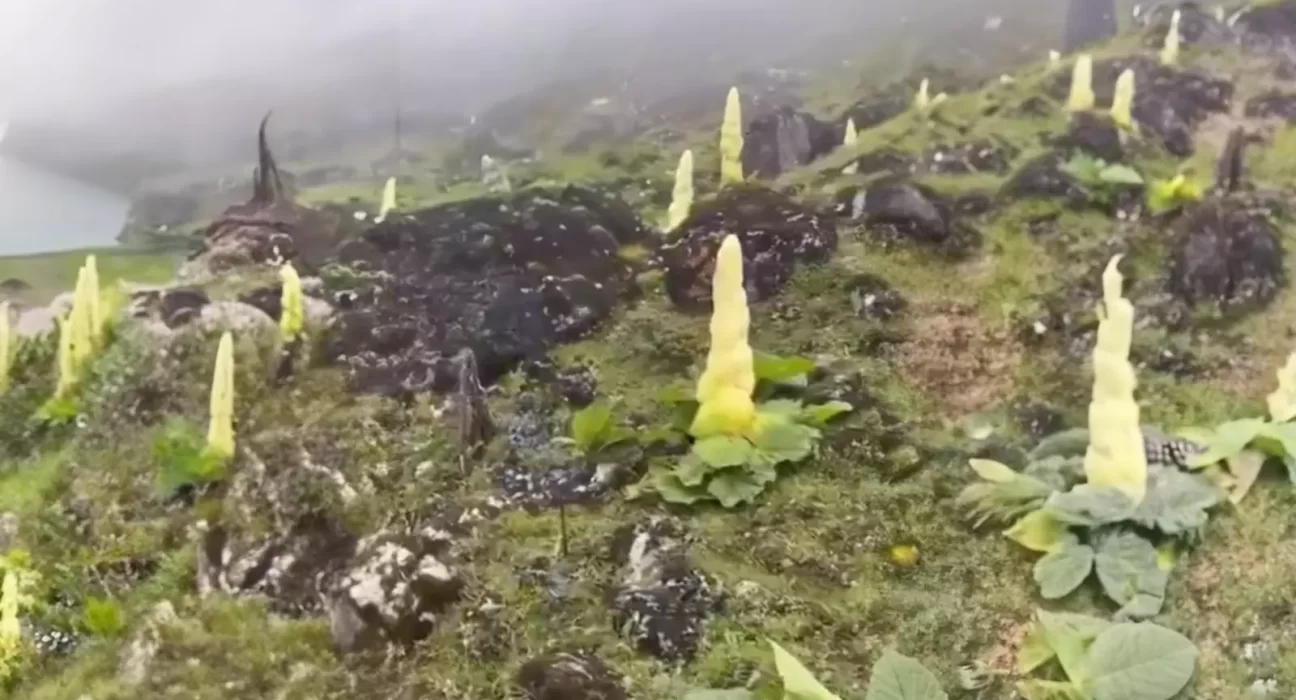
High within the desolate, wind-swept ridges of the Eastern Himalayas, a botanical phenomenon is currently captivating the world. The Sikkim Sundari (scientifically known as Rheum nobile), a plant as elusive as it is beautiful, has begun its rare and dramatic flowering sequence. Rising like a glowing pagoda from the rocky terrain at altitudes of 4,000 to 4,800 meters, this “Glasshouse Plant” serves as a breathtaking reminder of nature’s incredible patience and the fragile beauty of alpine ecosystems.
The life cycle of the Sikkim Sundari is nothing short of heroic. Classified as a monocarpic species, the plant spends the vast majority of its existence—anywhere from 7 to 30 years—as a modest, ground-hugging rosette of leaves. During these decades, it quietly accumulates energy amidst freezing temperatures and thin air. Then, in a final, spectacular act of biological resolve, it shoots upward into a tower nearly two meters tall, blooms, disperses its seeds, and subsequently dies. This “one-and-done” strategy has earned it the admiration of nature enthusiasts and industrial leaders alike, with business icon Anand Mahindra recently describing the plant as a “masterclass in patience.”
The plant’s most striking feature is its translucent, straw-colored bracts that overlap like delicate glass tiles. These are not merely for show; they function as a sophisticated natural greenhouse. By trapping solar radiation and blocking harmful ultraviolet rays, the bracts create a warm microclimate for the internal flowers, allowing them to develop in an environment that would otherwise be too hostile for life. This ingenious adaptation makes the Sikkim Sundari appear almost luminous, a beacon of gold visible across the vast, rugged mountain valleys.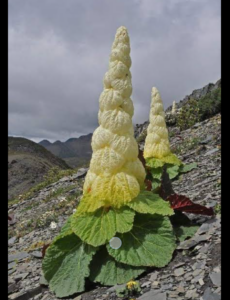

Beyond its aesthetic wonder, the Sikkim Sundari holds deep cultural and ecological significance. Locally known as Chuka, its roots have been used for generations in traditional Tibetan medicine for their anti-inflammatory properties. However, as global awareness of this rare bloom grows, the focus has shifted toward preservation. The sighting of a blooming Sundari is a rare privilege for trekkers and botanists, signaling a healthy, though sensitive, Himalayan habitat. Its sudden appearance reminds us that even in the harshest conditions, beauty and life can flourish if given enough time.
As the sun sets over the peaks of North Sikkim, the glowing towers of the Sikkim Sundari stand as silent sentinels of resilience. They teach us that greatness is often worth the wait and that true glory is found in enduring the cold until the moment is right to shine. For those lucky enough to witness this once-in-a-decades event, the Sikkim Sundari is not just a flower—it is a symbol of the eternal spirit of the Himalayas.