









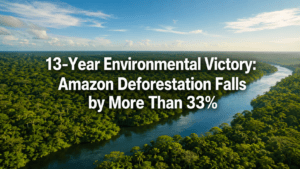
A Green Hope: Amazon Deforestation Falls to Its Lowest Level in 13 Years
In a time when environmental news can often feel worrying, a remarkable development from Brazil offers genuine hope. Recent satellite data shows that deforestation alerts in the Brazilian Amazon have fallen to their lowest level in 13 years. This encouraging achievement demonstrates that determined government action, advanced technology and community participation can make a meaningful difference in protecting the natural world.
According to Brazil’s National Institute for Space Research, known as INPE, deforestation alerts covered approximately 2,874 square kilometres of the Amazon during the 12 months ending on 31 July 2026. Although this remains a considerable area of forest, the figure represents a decline of more than one-third compared with the previous 12-month period. It is also approximately 55.6% below the average recorded during the past decade. Positive News reported on the latest satellite findings.
Why the Amazon Matters
The Amazon is the world’s largest tropical rainforest and one of the most important ecosystems on Earth. It stretches across several South American countries, with the largest portion located in Brazil. The forest is home to an extraordinary variety of plants, animals, birds and insects, including many species found nowhere else in the world.
It is also home to numerous Indigenous communities whose cultures, traditions and livelihoods have been connected to the forest for generations. Protecting the Amazon is therefore not only an environmental responsibility but also a matter of protecting people, knowledge and cultural heritage.
The forest plays a vital role in regulating rainfall, storing carbon and supporting the global climate system. Trees absorb carbon dioxide from the atmosphere as they grow. When forests are cut down or burned, much of this stored carbon is released, contributing to climate change. Reducing deforestation is consequently one of the most effective ways to limit greenhouse-gas emissions while preserving biodiversity.
Technology Is Helping Protect the Forest
One of the key tools supporting this progress is satellite monitoring. INPE has operated a satellite-based alert system for the Brazilian Amazon since 2004. The system helps authorities identify areas where forest clearing may be taking place, allowing enforcement teams to respond more quickly.
Instead of waiting months or years to discover that a large area has disappeared, authorities can use frequently updated satellite images to locate possible illegal activity. This information can support inspections, investigations, fines and other protective measures. INPE describes the system as an important alert tool for monitoring and controlling deforestation in the region. Learn about INPE’s Amazon-monitoring system.
Technology alone, however, cannot protect a forest. Satellite information becomes powerful only when governments, environmental agencies, local communities and law-enforcement teams act upon it. The latest decline suggests that coordinated monitoring and enforcement can produce real results.
A Victory, but Not the End of the Journey
The fall in deforestation alerts deserves to be celebrated, but it should not create complacency. Thousands of square kilometres of forest are still being affected, while illegal logging, mining, land grabbing, agricultural expansion, drought and wildfires continue to threaten the Amazon.
Deforestation alerts are also not identical to the final, officially confirmed annual deforestation rate. Alert systems are designed to quickly identify possible forest loss, while more detailed assessments are later used to calculate final figures. Nevertheless, such a substantial reduction in alerts provides an encouraging indication of progress.
Brazil has pledged to eliminate deforestation by 2030. Achieving that ambitious goal will require consistent environmental policies, adequate funding, strong law enforcement and long-term support for Indigenous peoples and local forest communities. Sustainable employment opportunities will also be essential so that families living in the Amazon region can earn a secure income without destroying the forest around them.
A Lesson for the World
This positive news carries a message that extends far beyond Brazil: environmental damage is not always irreversible, and progress is possible when societies decide to act.
The decline did not happen because of one person or one single policy. It reflects the combined contribution of scientists studying satellite images, officers investigating illegal activities, Indigenous communities defending their territories, conservationists restoring damaged areas and citizens demanding responsible environmental leadership.
It also reminds us that positive environmental change often happens gradually. A protected area, a prevented fire or a reduction in illegal clearing may appear small individually. Together, however, these actions can preserve an enormous landscape and protect countless living creatures.
For young people especially, the story offers an important lesson. Climate change and biodiversity loss are serious challenges, but they are not reasons to surrender hope. Hope becomes meaningful when it encourages action—planting and protecting trees, reducing unnecessary waste, learning about wildlife, supporting responsible businesses and speaking up for environmental protection.
The Amazon still faces major challenges, but its lowest level of deforestation alerts in 13 years is a powerful sign of what humanity can accomplish. The forest’s future is not yet guaranteed, but this achievement proves that recovery is possible. When science, policy and people work together, even one of the world’s greatest environmental challenges can begin to move in a better direction.