









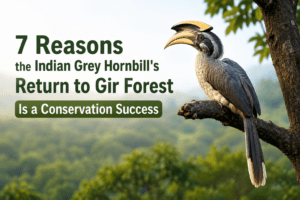
Rare Indian Grey Hornbills Return to Gujarat’s Gir Forest After 60 Years
A Remarkable Conservation Success Story That Brings New Hope for India’s Wildlife
Introduction
In a world where stories of habitat loss and declining wildlife populations often dominate environmental news, Gujarat has delivered a heartening success story. After being absent from the Gir Forest for more than six decades, the Indian Grey Hornbill has made a remarkable return. Even more encouraging, the birds have not only adapted to their new home but have also bred successfully for four consecutive years, indicating that the population is becoming self-sustaining.
This achievement is the result of years of careful planning, scientific research, habitat restoration, and collaboration between forest officials, conservationists, and local communities. The return of the Indian Grey Hornbill is not just about bringing back a bird species—it represents the recovery of an entire ecosystem and demonstrates what can be achieved through long-term conservation efforts.
The Disappearance of a Beautiful Bird
The Indian Grey Hornbill was once commonly found in many parts of western India, including the Gir Forest. However, over time, habitat destruction, urban expansion, loss of mature trees, and changes in the natural landscape caused the species to disappear from the region.
Hornbills depend heavily on old, large trees that contain natural cavities where they build nests. As these trees became fewer, suitable nesting sites disappeared, making survival increasingly difficult. Without proper habitats, the birds gradually vanished from Gir, leaving a noticeable gap in the forest’s biodiversity.
For more than sixty years, the species remained absent from the region, and many believed it would be difficult for the bird to naturally return.
A Carefully Planned Conservation Project
Recognizing the ecological importance of hornbills, wildlife experts and the Gujarat Forest Department launched an ambitious conservation initiative. Between 2021 and 2023, around forty Indian Grey Hornbills were carefully reintroduced into the Gir landscape.
The project involved much more than simply releasing birds into the forest. Conservationists first assessed whether Gir could once again support a healthy hornbill population. They studied food availability, nesting opportunities, tree diversity, predator presence, and overall habitat quality before beginning the relocation.
The birds were closely monitored after their release using scientific tracking methods. Forest officials regularly observed their movement, feeding patterns, nesting behavior, and adaptation to the environment.
Signs of Success
The most exciting development came when researchers confirmed successful breeding. The hornbills have now nested and raised chicks for four consecutive breeding seasons, a strong indication that they have accepted Gir as their home.
Successful breeding is one of the most important indicators of wildlife conservation success. It shows that animals are finding enough food, suitable nesting sites, and safe conditions to reproduce naturally.
Experts believe this achievement demonstrates that the Gir ecosystem has recovered sufficiently to support species that once disappeared from the area.
Why Hornbills Are So Important
Hornbills are often called the “farmers of the forest.” This nickname reflects their vital role in maintaining healthy ecosystems.
These birds feed on a wide variety of fruits and later disperse seeds across large areas as they fly through forests. Many large forest trees depend on hornbills to spread their seeds naturally.
Without birds like hornbills, forest regeneration becomes slower, reducing biodiversity over time. Their return therefore benefits not only one species but also countless plants, insects, mammals, and other birds that depend on healthy forests.
Hornbills also serve as indicators of forest health. Their presence suggests that an ecosystem has sufficient mature trees, rich biodiversity, and stable environmental conditions.
The Role of Communities and Forest Officials
One of the biggest reasons behind this success is collaboration.
The Gujarat Forest Department worked closely with wildlife biologists, conservation organizations, researchers, veterinarians, and local communities throughout the project.
Residents living near Gir played an equally important role by supporting conservation efforts and helping protect habitats from illegal activities. Awareness campaigns encouraged people to value biodiversity while promoting coexistence between wildlife and surrounding communities.
This partnership highlights an important lesson in conservation: protecting wildlife becomes far more successful when local people actively participate rather than being excluded.
Challenges Still Remain
Although the return of the Indian Grey Hornbill is excellent news, conservationists emphasize that their work is far from complete.
Hornbills continue to depend on mature forests with large nesting trees. Illegal tree cutting, expanding human settlements, climate change, and habitat fragmentation remain ongoing threats.
Maintaining this success will require continued habitat protection, scientific monitoring, and responsible forest management. Conservation experts stress that long-term commitment is essential if the growing hornbill population is to thrive for future generations.
A Model for Wildlife Conservation
The Gir Forest is already globally recognized as the only natural home of the Asiatic Lion. The successful return of the Indian Grey Hornbill adds another remarkable chapter to Gujarat’s conservation achievements.
This project demonstrates that wildlife restoration is possible when decisions are based on scientific research, careful planning, and community participation. It offers hope for restoring other species that have disappeared from parts of India due to habitat loss.
Across the country, similar conservation projects could help revive native wildlife while strengthening ecosystems and protecting biodiversity.
Conclusion
The return of the Indian Grey Hornbill to Gujarat’s Gir Forest after more than sixty years is an inspiring reminder that nature has an extraordinary ability to recover when given the opportunity. Through dedication, scientific planning, habitat restoration, and community support, a species once lost from the region is once again becoming part of its natural landscape.
While continued conservation efforts remain essential, this achievement proves that positive environmental change is possible. Every successful wildlife restoration project strengthens ecosystems, protects biodiversity, and inspires future generations to value and preserve the natural world.
The comeback of the Indian Grey Hornbill is not just a victory for Gujarat—it is a symbol of hope for wildlife conservation across India and a reminder that when people and nature work together, remarkable recoveries can happen.