








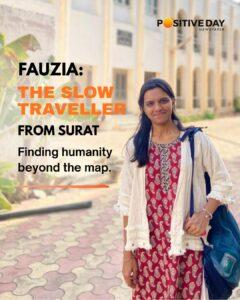
Fauzia: The Slow Traveller from Surat Finding Humanity Beyond the Map
In a world where travel is often measured by the number of destinations visited, photographs clicked and places checked off a list, Fauzia from Surat has chosen a different path.
She calls herself a slow traveller.
For Fauzia, travelling is not simply about reaching a destination. It is about staying long enough to understand a place — its people, culture, everyday life and untold stories. Through her platform, travelwithfauzia, she documents these experiences while also using her voice to draw attention to social and community issues she encounters along the way.
At the heart of everything she does is one simple belief: humanity matters.
It Started Just 20 Kilometres Away
Fauzia’s journey began in 2019.
At the time, she was working full-time but had begun to realise that spending her entire life following a conventional 9-to-5 routine was not what she wanted.
She had always enjoyed travelling, but until then most of her journeys had been connected to education or family.
One Sunday, she simply picked up her bag and stepped outside the city. Her mother joined her, and together they travelled to Variav, a village around 20 kilometres from Surat.
What she discovered surprised her.
So close to Surat’s busy urban life was a completely different rhythm — peaceful, tranquil and slow.
That simple trip became the beginning of something much bigger.
From Tourist to Slow Traveller
Initially, Fauzia travelled like many of us do.
She would reach a destination, follow an itinerary, visit the expected places and return home.
But a trip to Kashmir in 2025 changed her perspective.
Despite loving Kashmir, she returned feeling that something was missing. She had seen the destination, but she felt she had not truly understood its culture or people.
That realisation made her reflect on her previous journeys across places including Diu, Daman, the Dangs and parts of Himachal Pradesh and Uttarakhand.
By 2026, she knew she wanted to travel differently.
Instead of rushing from one destination to another, she began staying in places for weeks, giving herself the time to observe everyday life and understand the communities around her.
When Two Strangers Didn’t Need the Same Language
Some of Fauzia’s most meaningful travel memories have nothing to do with famous tourist attractions.
During a winter trip to Kashmir, she was travelling by local public transport from Srinagar towards Gulmarg. An elderly Kashmiri woman sat beside her and began speaking to her in the local language.
Fauzia did not understand Kashmiri.
The woman did not understand Fauzia’s Hindi.
Yet somehow, they continued talking.
Soon, other passengers joined the interaction. When the elderly woman finally left the bus, she kissed Fauzia on the cheek.
For Fauzia, that small interaction carried a much larger message: people do not always need the same language, religion or background to connect.
Sometimes, warmth itself becomes a language.
A similar moment happened during her travels in Kutch, where she met an elderly man knowledgeable about traditional veterinary practices. After a heartfelt conversation, he blessed her before she left.
She had been responsible and sustainable tourism.
Today, Fauzia remains in touch with him.
Travelling Without Trying to Change People
Perhaps one of the strongest lessons Fauzia has learned is the importance of entering communities with curiosity rather than judgement.
During a 16-day stay in Ladakh, she lived with members of the Shia community during Moharram.
On an important day of observance, her hosts followed traditions that included not lighting the stove. Yet when they realised Fauzia had not had her morning tea, they made it clear that their religious practice did not have to become hers.
She was free to prepare tea for herself.
That small gesture stayed with her.
For Fauzia, it demonstrated what coexistence can look like: practising your own beliefs while allowing another person the freedom to practise theirs.
It also strengthened her belief that travellers should not enter remote or indigenous communities assuming they need to “correct” or change them. Instead, she believes travellers should observe, listen and allow cultures to evolve naturally.
Giving Space to Stories That May Otherwise Disappear
Fauzia now hopes to use slow travel to understand and document rural India, particularly indigenous communities and nomadic tribes.
She worries that traditions, stories and ways of life may gradually disappear without being properly documented.
Her ambition is therefore larger than travel content.
She wants to listen to communities, document their lives, highlight their concerns and help their voices reach people who may otherwise never encounter their stories.
Travel has changed Fauzia too.
She says she once judged and stereotyped people more easily. Travelling exposed her to individuals with completely different beliefs, personalities and ways of living.
Over time, she learned not to generalise.
It has made her more confident, open and understanding — and even helped her discover something about herself she had not recognised before: her ability to tell stories.
The Journey Ahead
Fauzia now hopes to explore East India and spend months living close to indigenous communities, understanding their lives rather than simply passing through their regions.
But perhaps the biggest destination she is travelling towards cannot be found on a map.
She wants to see a society that is more compassionate, tolerant and empathetic — one where people can hold different beliefs, religions and cultures without demanding that others become like them.
And if someone reading her story wants to begin making a difference, Fauzia’s suggestion is surprisingly simple.
Start nearby.
Travel 20 kilometres outside your own city and observe what changes. Look closely at your surroundings. Notice an issue. Listen to another person.
Above everything else, her message comes down to two words:
Spread love.
Listen to someone without expecting anything back. Help someone without waiting for a favour. Offer food without first deciding whether someone deserves it.
In an age of fast travel, fast content and fast opinions, perhaps Fauzia’s journey reminds us of the value of slowing down.
Because sometimes, when we stop rushing through places, we finally begin to see the people who make them worth visiting.
Just be kind. Just be human. Read more positive news on positivedaynewspaper.