









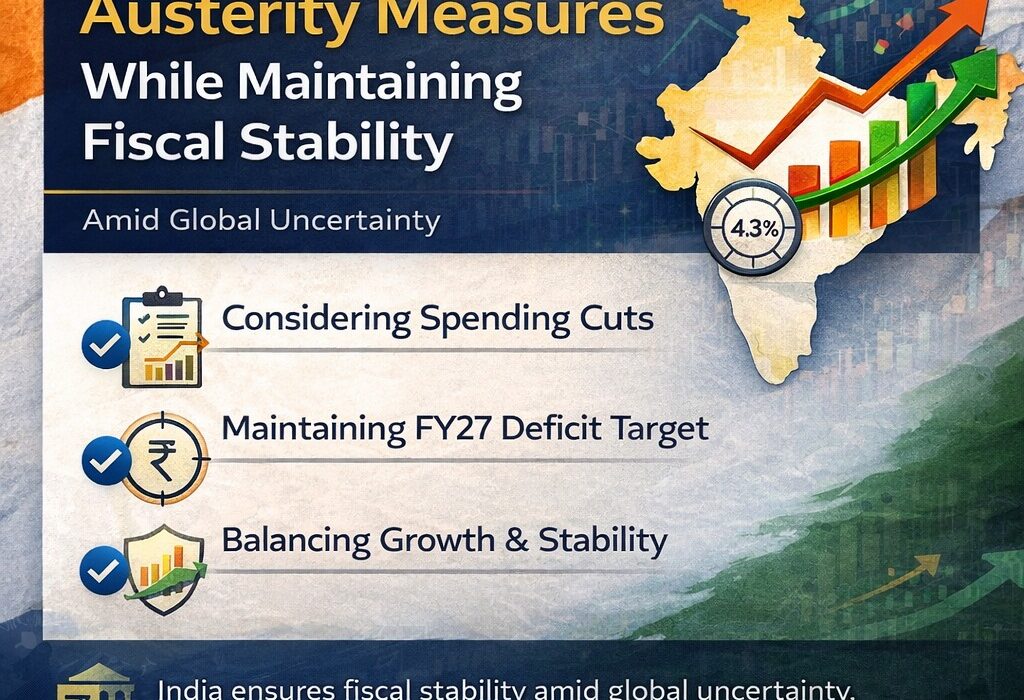
India Weighs Austerity Measures While Maintaining Fiscal Stability Amid Global Uncertainty
Introduction
India’s Strategic Move: Austerity Measures While Maintaining Fiscal Stability. In a time of global economic uncertainty, maintaining financial stability has become a key priority for governments around the world. Recent geopolitical tensions, particularly in the Middle East, have led to rising oil prices and increased pressure on national economies. In this context, India is carefully evaluating its fiscal strategy. While considering certain austerity measures to manage spending, the government remains confident that there is no immediate risk to its fiscal deficit target for the financial year 2026–27 (FY27). This balanced approach reflects India’s commitment to economic stability and sustainable growth.
Understanding Fiscal Deficit and Its Importance
The fiscal deficit is a crucial indicator of a country’s financial health. It represents the gap between the government’s total expenditure and its total revenue. A lower fiscal deficit indicates better financial management, while a higher deficit may signal excessive borrowing and economic stress.
India has set a fiscal deficit target of around 4.3% of its Gross Domestic Product (GDP) for FY27. Achieving this target is important not only for maintaining investor confidence but also for ensuring long-term economic stability. Therefore, any global or domestic factor that affects government spending or revenue requires careful attention.
Impact of Global Developments on India’s Economy
The ongoing tensions in the Middle East have had a direct impact on global oil prices. As a country that imports a significant portion of its crude oil, India is particularly sensitive to such changes. Rising oil prices can increase the government’s expenditure on subsidies, especially for fuel and fertilizers.
At the same time, the government may reduce taxes on fuel to protect consumers from rising prices. While this helps citizens, it can also reduce government revenue. Together, these factors create additional pressure on the fiscal balance, making it more challenging to meet deficit targets.
What Are Austerity Measures?
Austerity measures refer to steps taken by the government to reduce spending and control the fiscal deficit. These measures do not necessarily mean cutting essential services but rather optimizing expenditure and avoiding unnecessary costs.
In India’s case, the government is considering selective cost-cutting strategies. These may include reducing non-essential administrative expenses, delaying certain low-priority projects, and ensuring better utilization of allocated funds. The aim is to manage resources efficiently without affecting critical sectors.
Focus on Infrastructure and Growth
Despite considering austerity measures, India continues to prioritize capital expenditure, especially in infrastructure development. Investments in roads, railways, airports, and urban development remain a key part of the government’s growth strategy.
Infrastructure spending not only boosts economic activity but also creates employment opportunities and improves connectivity. By maintaining this focus, the government ensures that short-term financial adjustments do not compromise long-term growth objectives.
No Immediate Risk to Fiscal Targets
One of the most reassuring aspects of the current situation is the government’s confidence in meeting its fiscal deficit target. Officials have indicated that, despite global pressures, there is no immediate need to revise the FY27 target.
This suggests that India’s financial position remains stable and well-managed. The government is closely monitoring the situation and is prepared to take further action if required. However, at present, the overall outlook remains under control.
Balancing Stability and Flexibility
India’s approach reflects a careful balance between caution and confidence. On one hand, the government is preparing for potential challenges by considering austerity measures. On the other hand, it is maintaining flexibility by continuing investments in key sectors.
This dual strategy is essential in today’s uncertain global environment. It allows the country to respond effectively to external shocks while ensuring that economic growth remains on track.
Impact on Businesses and Investors
For businesses and investors, this development sends a positive signal. It shows that the government is proactive and responsive to changing global conditions. By managing its finances responsibly, India reinforces its reputation as a stable and reliable investment destination.
Investor confidence is closely linked to fiscal discipline. When the government demonstrates control over its budget, it encourages both domestic and international investors to remain engaged in the market.
Long-Term Economic Outlook
Looking ahead, India’s strategy of combining fiscal discipline with growth-oriented spending is likely to support long-term economic progress. While short-term challenges may arise due to global factors, the country’s strong policy framework provides a solid foundation for resilience.
Continued monitoring, timely interventions, and a focus on efficient resource utilization will be key to navigating future uncertainties. If these measures are implemented effectively, India can maintain its growth momentum while keeping its finances under control.
Conclusion
India’s decision to consider austerity measures while maintaining its fiscal deficit target reflects a thoughtful and balanced approach to economic management. Although global developments have created some pressure, the government’s proactive planning ensures that the situation remains under control.
By focusing on efficient spending, protecting key investments, and maintaining fiscal discipline, India demonstrates its ability to navigate complex economic challenges. This approach not only supports current stability but also strengthens the foundation for future growth, reinforcing India’s position as a resilient and forward-looking economy.