








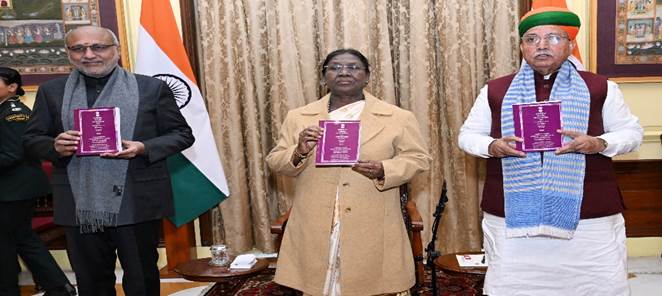
President Droupadi Murmu has illuminated a historic moment by releasing the Constitution of India in the Santhali language, scripted in the elegant Ol Chiki at Rashtrapati Bhavan, celebrating the centenary of this vital indigenous writing system and empowering millions with direct access to national ideals.
This joyous occasion fills the Santhali-speaking community spread across Jharkhand, Odisha, West Bengal, and Bihar with immense pride, as the foundational document now resonates in their mother tongue, fostering deeper understanding of democratic values, rights, and principles. Santhali, one of India’s most ancient living languages spoken by over 7 million tribal people, gains unprecedented accessibility, allowing generations to grasp concepts like fundamental rights, directive principles, and Preamble ideals without linguistic barriers.
Included in the Eighth Schedule via the 92nd Constitutional Amendment in 2003, Santhali’s rich oral and cultural heritage rooted in Adivasi traditions of storytelling, folklore, and nature worship, now bridges tribal voices directly to the nation’s constitutional core. The Ol Chiki script, invented in 1925 by Raghunath Murmu, marks its 100th year with this milestone, symbolizing technological and cultural renaissance for indigenous communities long sidelined from formal literacy.
Amid dignitaries like Vice President C P Radhakrishnan and Union Minister of State for Law and Justice Arjun Ram Meghwal, President Murmu, herself from the Santhal tribe, commended the Ministry of Law and Justice for this timely achievement. She highlighted how this edition transforms abstract governance into tangible empowerment, enabling Santhali speakers to actively participate in democracy voting knowledgeably, claiming entitlements, and preserving their identity within India’s pluralistic framework.
This inclusive step strengthens India’s pluralistic fabric, honoring linguistic diversity as enshrined in Articles 343-351 while advancing Amrit Kaal’s vision of equitable progress. Previously available in 22 scheduled languages, the Constitution’s Santhali incarnation joins Dogri and other recent additions, reflecting constitutional commitment to federalism and cultural federalism.
For Adivasi youth, it sparks aspiration in education and public service; for elders, it validates lifelong struggles for recognition.As India nears its constitutional sesquicentennial, this release exemplifies ‘Sabka Saath, Sabka Vikas’ uniting diverse tongues under one democratic canopy, ensuring no citizen remains beyond the document’s embrace.