








The Silent Shift in Education: How India Is Moving from Degrees to Skills
A Change That Most People Haven’t Noticed
While headlines often focus on exams, results, and rankings, a more meaningful shift is happening quietly within India’s education system. It’s not loud or viral, but it has the potential to reshape how students learn and build their careers.
Recent developments at Himachal Pradesh Technical University highlight this change. The university approved a ₹76 crore budget with a strong focus on research, innovation, and student development. At first glance, it may seem like a routine financial update—but the direction of this investment tells a much bigger story.
Where the Focus Is Shifting
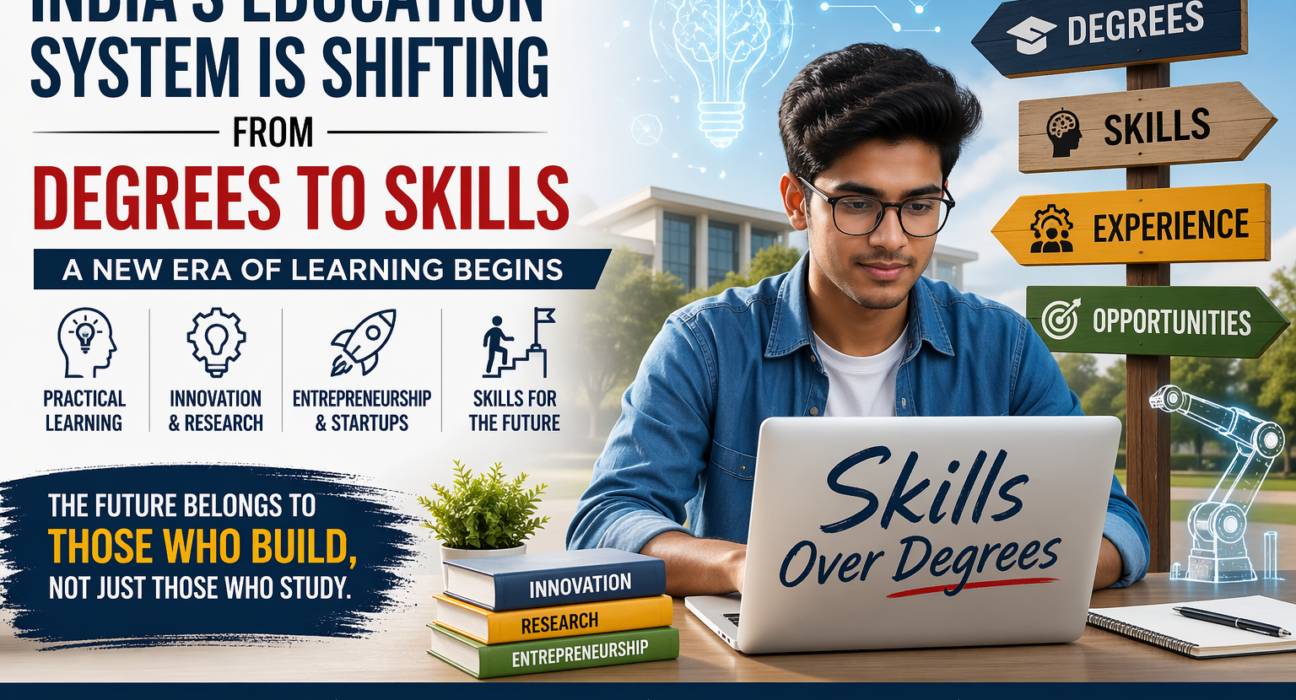
Traditionally, education has been centered around textbooks, lectures, and exams. Success was measured through marks and degrees. However, institutions are now gradually shifting their focus toward more practical and skill-based learning.
The new budget prioritizes:
- Research infrastructure and modern laboratories
- Access to digital learning resources
- Support for innovation and startup culture
- Development of extracurricular and practical skills
This indicates a clear move away from passive learning toward a more active, hands-on approach.
Learning Beyond the Classroom
One of the most important changes is the increased emphasis on research and experimentation. With better labs and funding, students are no longer limited to theoretical knowledge. They can now test ideas, work on real-world problems, and gain practical experience.
This shift allows students to:
- Understand concepts more deeply
- Build projects that reflect real skills
- Develop problem-solving abilities
In simple terms, learning is becoming more about doing rather than just studying.
Encouraging Innovation and Entrepreneurship
Another key focus area is innovation. Universities are now encouraging students to think beyond traditional career paths. Instead of only preparing for jobs, students are being supported to create their own opportunities.
Startup culture within campuses is growing, with more emphasis on:
- Entrepreneurship programs
- Innovation challenges
- Skill-based competitions
This approach helps students develop confidence, creativity, and independence—qualities that are essential in today’s world.
The Rise of Skill-Based Education
The biggest takeaway from this shift is the increasing importance of skills. While degrees still matter, they are no longer enough on their own.
Employers today are looking for:
- Practical knowledge
- Real-world experience
- Problem-solving skills
- Adaptability
This means students need to focus on building abilities that go beyond textbooks. The education system is slowly adapting to meet these expectations.
A Larger Trend Across India
What’s happening at one university is not an isolated case. Similar changes are being seen across institutions in India. Educational policies, funding decisions, and campus initiatives are all pointing toward a common goal: making learning more relevant to the real world.
Even events at institutions like Indian Institute of Information Technology Allahabad, where students participate in innovation-driven tech festivals, reflect this growing emphasis on creativity and application-based learning.
Why This Matters for Students
This shift has a direct impact on how students should approach their education. Instead of focusing only on grades, students now need to:
- Build skills alongside academic knowledge
- Work on projects and practical experiences
- Explore creative and entrepreneurial opportunities
The path to success is no longer linear. It’s becoming more flexible, allowing individuals to shape their own journeys.
Balancing Knowledge and Application
It’s important to understand that this shift does not mean traditional education is becoming irrelevant. Instead, it’s about finding a balance between theory and practice.
Strong foundational knowledge is still important, but it needs to be complemented with real-world application. This balance helps students not only understand concepts but also use them effectively.
A Quiet but Powerful Transformation
What makes this change interesting is how quietly it is happening. There are no dramatic announcements or viral trends, yet the impact is significant.
This transformation is:
- Gradual
- Practical
- Future-focused
It reflects a deeper understanding of what modern education should look like.
Final Thought
India’s education system is not changing overnight, but it is evolving in the right direction. The growing focus on skills, innovation, and real-world learning shows that the system is adapting to meet the needs of the future.
For students, this is an opportunity. It’s a chance to move beyond traditional expectations and take a more active role in shaping their learning journey.
Because in today’s world, success is not defined by what you know alone—
but by what you can actually do with that knowledge.
You can learn more about India’s education initiatives on the official government portal.